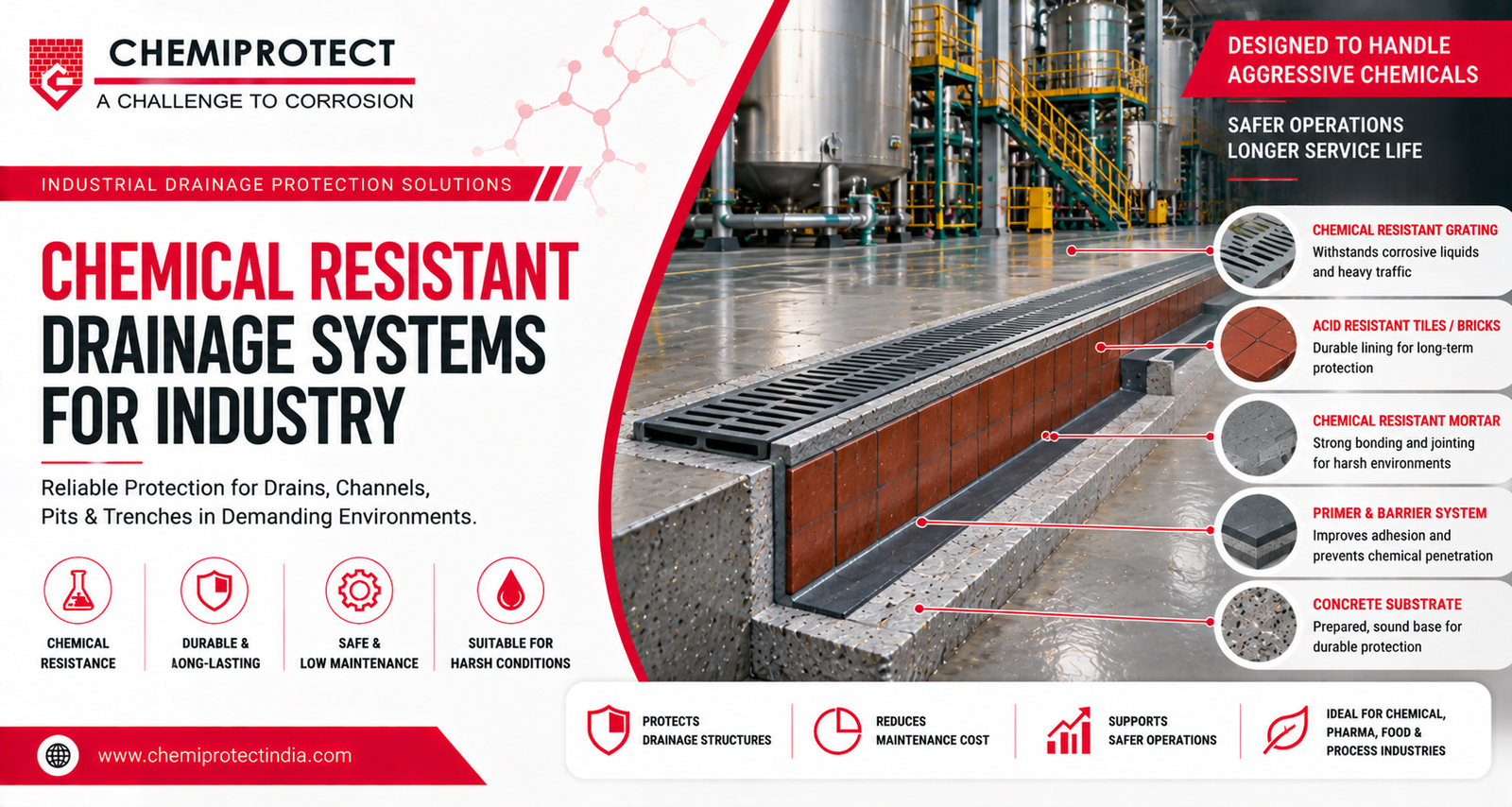
Chemical Resistant Drainage Systems for Industry
Industrial drainage systems are exposed to
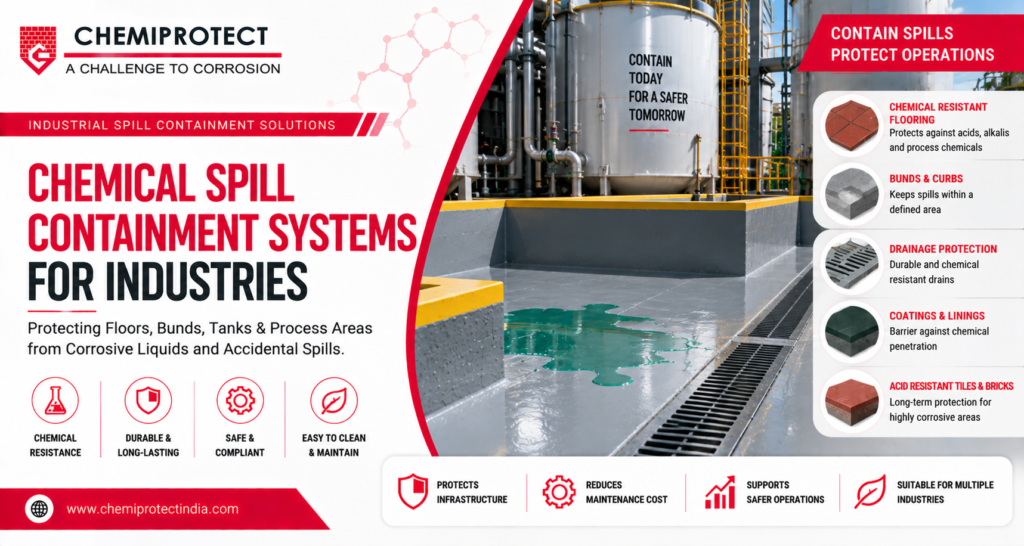
Industrial facilities that handle chemicals need surfaces capable of dealing with accidental spills, process liquids, cleaning chemicals, and contaminated wastewater. A spill that reaches unprotected concrete can lead to surface deterioration, chemical penetration, difficult cleanup, and costly repairs. Chemical Resistant Industrial Protection Solutions.
can form part of a broader strategy for protecting floors, bunds, pits, trenches, tanks, and other areas where chemical containment is important.
Chemical spill containment systems are engineered protective arrangements designed to control and contain aggressive liquids while helping protect the underlying structure. Depending on the application, a system may include chemical-resistant flooring, coatings, linings, joint protection, bund areas, curbs, collection pits, or tank linings.
The objective is to prevent spilled chemicals from quickly reaching vulnerable construction materials and to provide a surface that can be cleaned, inspected, and maintained. The system should be selected according to the chemicals handled, concentration, temperature, expected spill conditions, and physical demands of the area.
Chemical spills can create both operational and infrastructure challenges. Aggressive liquids may attack concrete, steel, joints, coatings, or other materials if they remain in contact with an unsuitable surface. Even short-duration exposure can become significant when spills occur repeatedly.
A well-designed containment area provides a controlled zone for handling accidental releases. It can help direct liquids toward collection points and reduce uncontrolled spread across production areas, access routes, or adjacent equipment.
Chemical plants may require protected floors, bunds, transfer areas, trenches, and collection pits where acids, alkalis, solvents, or process chemicals are handled.
Processing facilities can experience cleaning chemicals, moisture, and process liquids. Protective surfaces should support hygiene, durability, easy maintenance, and expected exposure.
Battery manufacturing, recycling, and electroplating may involve corrosive substances. Containment surfaces can help protect surrounding concrete and control localized spills.
Storage and transfer zones can require durable protection around tanks, pumps, pipelines, or handling equipment. Design should reflect the materials stored and transferred.
The base provides the physical foundation of the containment area. Concrete should be sound, appropriately prepared, and compatible with the selected protective system. Cracks, joints, moisture, contamination, and weak surface material should be assessed before application.
A chemical-resistant coating or lining can create a barrier between the spilled liquid and the underlying substrate. Epoxy, polyurethane, glass-flake, brick, and tile-based systems can be considered according to exposure and service requirements. Industrial Coating and Lining Services.
Joints, corners, penetrations, drains, equipment bases, and transitions need careful detailing because they can become weak points in a containment system. Materials used at these locations should be compatible with the main protective layer.
Physical containment features can keep spilled liquids within a defined area and guide them toward collection points. Their arrangement should reflect the facility’s process and spill-control requirements.
A suitable protective barrier can reduce direct chemical contact with concrete and other construction materials, helping limit premature deterioration.
Keeping a spill within a controlled area can make response and cleanup more manageable. Containment should support the facility’s chemical handling procedures.
Containment areas can experience chemicals, moisture, abrasion, impact, traffic, and cleaning. A suitable system can improve performance under these stresses.
Repeated chemical damage can result in repairs and disruption. Appropriate protection can reduce avoidable deterioration and extend the useful life of the area.
Begin with the substances that may contact the surface. Consider chemical type, concentration, temperature, exposure duration, frequency of spills, and whether multiple chemicals may be present.
Consider exposure duration, liquid collection, spill response, traffic, impact, abrasion, vibration, and cleaning methods.
Concrete condition, surface profile, moisture, cracks, joints, and existing coatings can influence material selection and preparation. The protective system should be compatible with the substrate and surrounding construction.
Containment performance depends on more than the coating. Flooring, joints, drains, curbs, bunds, collection points, and transitions should work together without unprotected paths.
Even a chemically resistant material can fail when the surface is poorly prepared or the system is incorrectly installed. Cleaning, surface preparation, mixing, application thickness, curing, joint detailing, and termination points should be controlled.
Pay particular attention to drains, corners, penetrations, construction joints, and equipment bases because chemical and mechanical stresses can concentrate there.
Product data sheets, safety information, installation guidance, detail drawings, and chemical resistance charts can support specification and quality control. Chemical Resistance and Installation Resources.
Regular inspection can help identify cracks, worn areas, damaged joints, coating defects, or standing liquids before they become larger problems. Spill containment areas should be kept clean so that residues do not remain on the protective surface longer than necessary.
Chemical spills should be handled according to facility safety procedures. Repairs should address the damage source and use materials compatible with the existing coating or lining.
Chemiprotect Engineers has been developing acid-proofing and corrosion-resistant solutions since 1970. Its range includes acid and alkali resistant mortars, epoxy products, glass-flake systems, polyurethane products, acid-resistant bricks and tiles, waterproofing products, and construction chemicals.
The company serves chemical processing, pharmaceuticals, fertilizers, electroplating, battery manufacturing, food, beverage, power, steel, petroleum, and other industrial sectors. Its customized approach considers project-specific exposure and operating conditions.
Chemical spill containment systems for industries are an important part of protecting facilities where corrosive liquids, process chemicals, cleaning agents, and contaminated wastewater are handled. A successful system should contain spills, protect the underlying structure, and provide a surface that can be inspected and maintained.
The right solution may combine a prepared concrete base with coatings, linings, joint protection, bunds, curbs, drains, and collection points. Selection should consider chemical type, concentration, temperature, spill frequency, traffic, abrasion, substrate condition, and maintenance.
Before specifying a system, evaluate the complete containment area rather than selecting a coating in isolation. Explore Chemiprotect’s industrial protection solutions.
for engineered approaches to chemical-resistant flooring, linings, coatings, waterproofing, and industrial surface protection.
A chemical spill containment system is an engineered protective system designed to contain aggressive liquids and protect concrete, steel, and other industrial structures.
They are used in chemical processing facilities, pharmaceutical plants, food industries, battery manufacturing, electroplating, and petroleum storage areas.
The system may include a chemical resistant floor, protective coating or lining, joint treatment, bunds, curbs, and collection pits.
Selection should consider chemical type, concentration, temperature, spill frequency, traffic, substrate condition, and the complete containment design.
Proper surface preparation, curing, joint detailing, and termination details help ensure long-term chemical resistance and reliable containment performance.
When used with chemical resistant masonry units and the proper membrane MIPRO-VE will protect concrete and steel sub base from chemical attacks and physical abuse. MIPRO-VE is silica filled vinyl ester mortar supplied in two parts .
Industrial drainage systems are exposed to
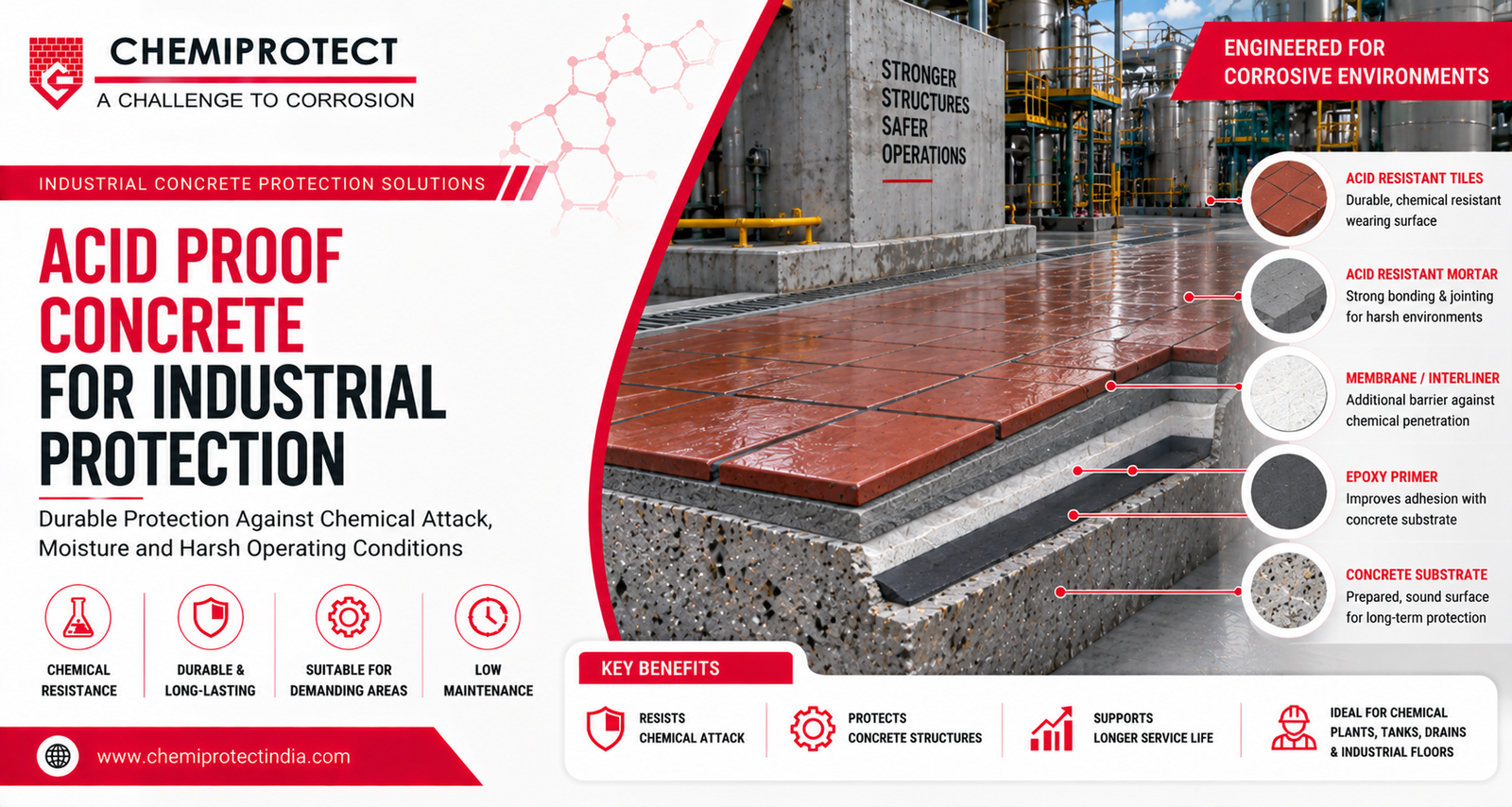
Industrial concrete structures face demanding conditions
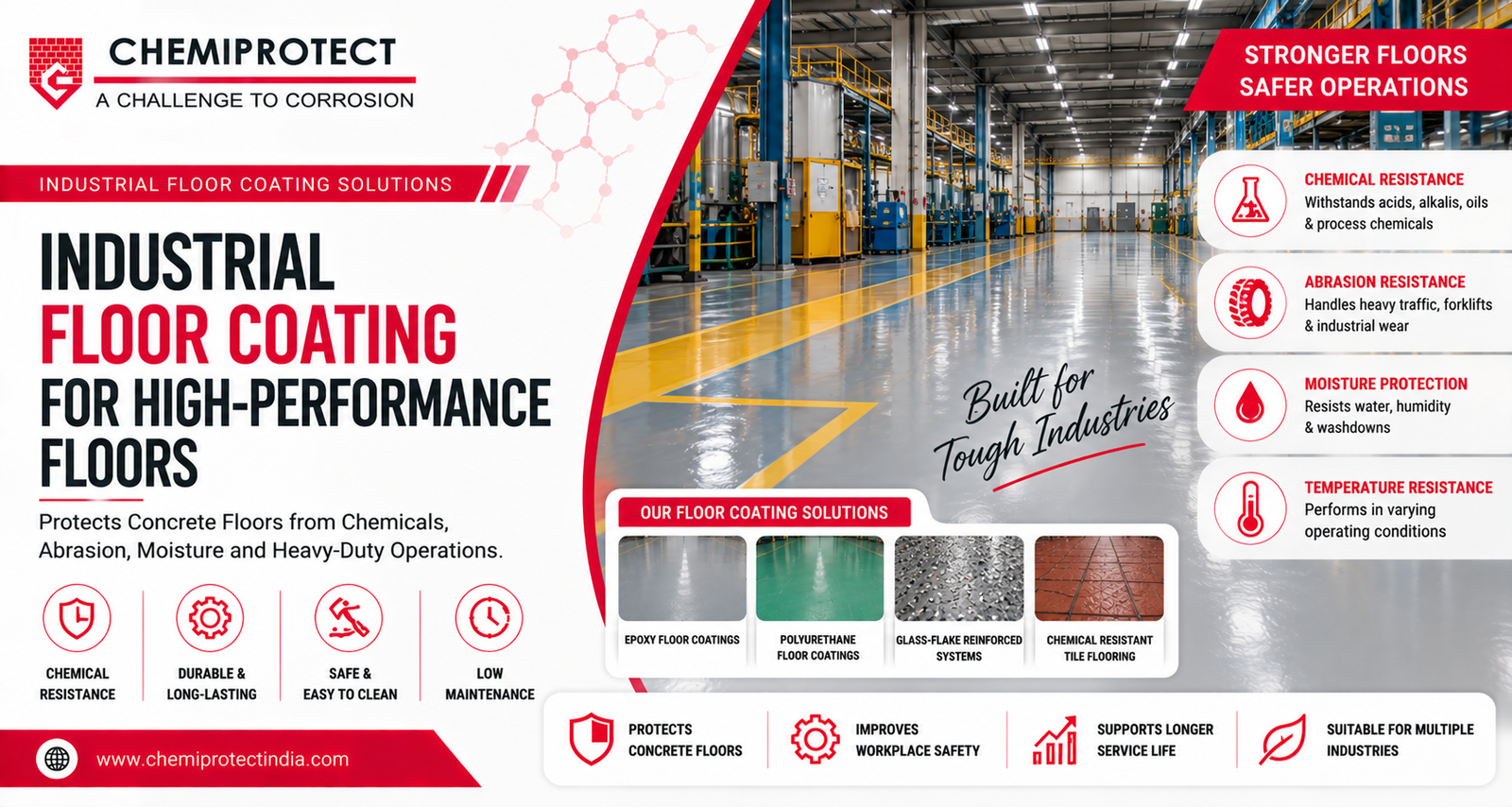
Industrial Floor Coating: A Practical Guide
Connect Now