Glass Flake Lining vs Epoxy Coating: Which Protection System Fits Your Application?
Glass Flake Lining vs Epoxy Coating: Which Protection System Fits Your Application?
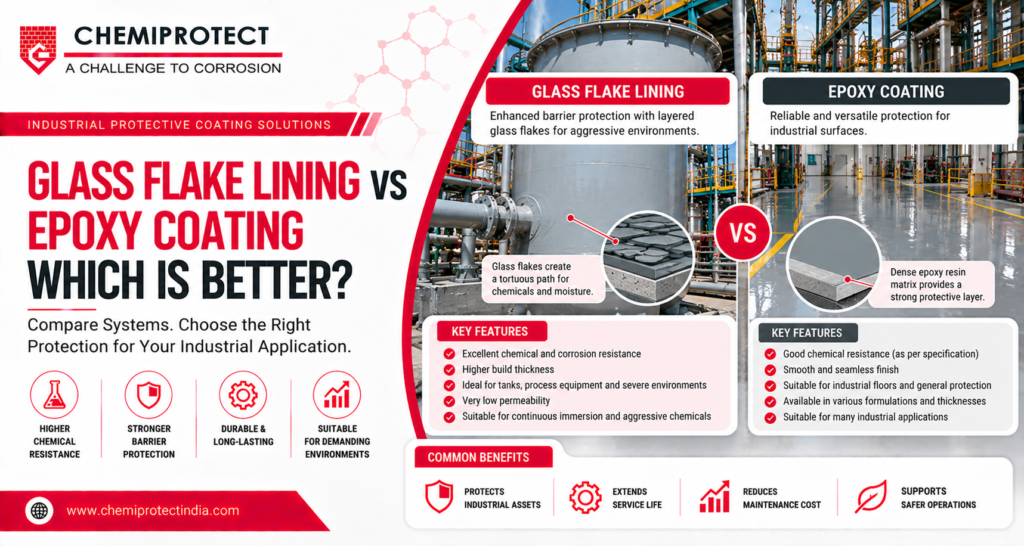
Understanding Glass Flake Lining and Epoxy Coating
Industrial surfaces exposed to acids, alkalis, solvents, salts, moisture, and process chemicals need protection selected around their actual service conditions. Two systems frequently considered are glass flake lining and epoxy coating. Although both can provide chemical and corrosion protection, they are not identical systems and should not be treated as interchangeable.
A glass flake lining system incorporates thin glass flakes within a resin matrix to create a dense barrier, while epoxy coatings use epoxy resin formulations designed to adhere to and protect prepared substrates. The right selection depends on chemical exposure, temperature, immersion, mechanical stresses, substrate condition, thickness requirements, and the intended service life.
What Is Glass Flake Lining?
Glass flake lining is a resin-based protective system containing numerous thin glass flakes distributed through the cured matrix. These flakes create a more tortuous path for chemicals and moisture attempting to move through the coating. The resulting structure is commonly used where strong barrier properties and resistance to aggressive environments are required.
Where Glass Flake Systems Are Considered
Glass flake systems can be considered for process equipment, tanks, pipelines, chemical handling areas, containment structures, floors, and other industrial surfaces exposed to corrosive environments. They can be particularly relevant where chemical contact or immersion places significant demands on the protective barrier.
What Is an Epoxy Coating?
Epoxy coatings are resin-based protective coatings formed by reacting epoxy resin with a curing agent. They are widely used because they can provide adhesion, hardness, chemical resistance, and a relatively seamless surface when correctly specified and applied.
Epoxy formulations vary considerably. Different resin systems, fillers, pigments, curing agents, and formulations can produce different levels of chemical, thermal, abrasion, and impact resistance. An epoxy intended for general industrial flooring should therefore not automatically be assumed to have the same performance as an epoxy system engineered for severe chemical exposure.
For industrial projects, chemical-resistant coating solutions should be selected against the actual chemical environment and operating conditions, rather than by resin name alone.
Glass Flake Lining vs Epoxy Coating: Key Differences
1. Barrier Structure
The physical structure of the systems is a major difference. In glass flake lining, the embedded flakes create overlapping barrier elements within the resin matrix. This arrangement increases the effective diffusion path through the coating. Conventional epoxy coatings depend primarily on the cured resin matrix and formulation to provide the protective barrier.
2. Chemical Exposure
Both systems can be formulated for chemical resistance, but compatibility must be checked for the specific chemical, concentration, temperature, and exposure pattern. Splash, intermittent contact, continuous contact, and immersion should not be treated as equivalent conditions. A resistance chart or technical data sheet should be consulted for the exact formulation.
3. Thickness and Film Build
Glass flake linings are commonly designed as higher-build protective barriers than many conventional coatings. Film thickness influences barrier performance, pinhole control, mechanical resistance, and the ability of the system to tolerate service conditions. Epoxy systems are available across a broad range of thicknesses, from relatively thin protective coats to heavy-duty flooring and lining systems.
4. Abrasion and Mechanical Conditions
Chemical resistance alone does not determine suitability. Floors may experience forklift traffic, dragging, impact, and abrasive particles, while process equipment can experience vibration and thermal cycling. The selected formulation and system thickness should therefore be assessed against the mechanical environment as well as chemical exposure.
5. Application and Substrate Preparation
Both systems depend on proper substrate preparation. Contaminants, weak concrete, laitance, rust, old coatings, and moisture conditions can affect adhesion and finished performance. Surface profile, primer selection, mixing, application thickness, curing, and inspection should follow the product’s technical requirements.
When Glass Flake Lining May Be Considered
Glass flake lining may be considered when the project calls for a dense, high-build barrier in a chemically aggressive environment. It can be relevant to tanks, vessels, chemical storage areas, process equipment, and other surfaces where reducing permeation and protecting the substrate are important design objectives.
Its suitability still depends on the resin chemistry and exact operating environment. The presence of glass flakes does not make a product universally resistant to every acid, alkali, solvent, or mixed chemical exposure.
When Epoxy Coating May Be Considered
Epoxy can be considered where a seamless, hard, adherent protective surface is required and the selected formulation is compatible with the exposure. Epoxy systems are widely used for industrial floors, walls, secondary containment areas, machinery zones, and process spaces.
The range of epoxy formulations also allows systems to be designed around different priorities, including chemical resistance, abrasion resistance, decorative finish, or ease of cleaning. The specific product and system build-up should be matched to the service conditions.
How to Select Between the Two Systems
Start by preparing an exposure profile. Identify every chemical likely to contact the surface, including cleaning agents and process residues. Record concentration, temperature, frequency, and duration of contact. Determine whether the area experiences immersion, splash, spills, condensation, or wash-down.
Next, evaluate the substrate and physical environment. Concrete moisture, cracking, joints, traffic, impact, abrasion, thermal movement, and drainage can influence system selection. For floors, slip resistance and cleaning requirements may also be relevant. For tanks or equipment, immersion and operating temperature may become more important.
Finally, compare the complete system design rather than a single material. Primer, resin layer, reinforcement, topcoat, thickness, joint treatment, and detailing can all contribute to performance. Chemiprotect’s technical resources provide product and system information that can help project teams evaluate industrial chemical protection requirements.
Common Selection Mistakes to Avoid
A frequent mistake is choosing a glass flake lining or epoxy coating solely because it is described as chemical resistant. Chemical resistance is formulation-specific. Another mistake is comparing products based only on price per square metre without considering required thickness, preparation, number of coats, curing, and expected maintenance.
Ignoring the substrate can create another problem. Even a chemically compatible system may fail prematurely if moisture, contamination, inadequate surface preparation, movement, or defective detailing prevents proper adhesion. Drains, joints, edges, penetrations, and equipment bases should receive particular attention.
A System-Based Approach to Industrial Protection
The comparison between glass flake lining and epoxy coating is most useful when treated as a system-design question. Glass flake technology can provide a dense barrier structure suited to demanding environments, while appropriately formulated epoxy systems can provide versatile seamless protection across many industrial applications.
Neither label alone determines performance. The final specification should consider chemical compatibility, temperature, exposure pattern, film build, mechanical stresses, substrate conditions, detailing, application method, and maintenance requirements. This approach makes the selection more closely aligned with the actual operating environment.
Conclusion
Glass flake lining and epoxy coating can both play important roles in industrial corrosion and chemical protection, but their construction and performance characteristics differ. Glass flake systems use embedded glass flakes to create a dense barrier, whereas epoxy systems rely on the properties of their specific resin formulation and system design.
The appropriate choice should be based on the complete exposure profile and project requirements, not on a generic assumption that one material is suitable for every environment. For facilities evaluating industrial acid-proofing and chemical protection systems, a project-specific assessment can help determine the appropriate coating or lining configuration.
FAQs
1. What is the difference between glass flake lining and epoxy coating?
Glass flake lining uses embedded glass flakes within a resin matrix to create a dense barrier, while epoxy coating relies on the properties of its specific epoxy formulation and system design.
2. When may glass flake lining be considered?
Glass flake lining may be considered for chemically aggressive environments requiring a dense, high-build barrier, such as tanks, vessels, chemical storage areas, and process equipment.
3. When may epoxy coating be considered?
Epoxy can be considered where a seamless, hard, adherent protective surface is required, including industrial floors, walls, containment areas, machinery zones, and process spaces.
4. What factors should be considered when choosing between glass flake and epoxy?
Consider chemical type and concentration, temperature, exposure duration, immersion, substrate condition, traffic, abrasion, impact, drainage, and required film thickness.
5. Is glass flake lining resistant to every chemical?
No. Glass flake systems are not universally resistant to every acid, alkali, solvent, or mixed chemical exposure. The specific resin chemistry and actual operating conditions must be checked.
Let’s Blog
Latest Blog
When used with chemical resistant masonry units and the proper membrane MIPRO-VE will protect concrete and steel sub base from chemical attacks and physical abuse. MIPRO-VE is silica filled vinyl ester mortar supplied in two parts .
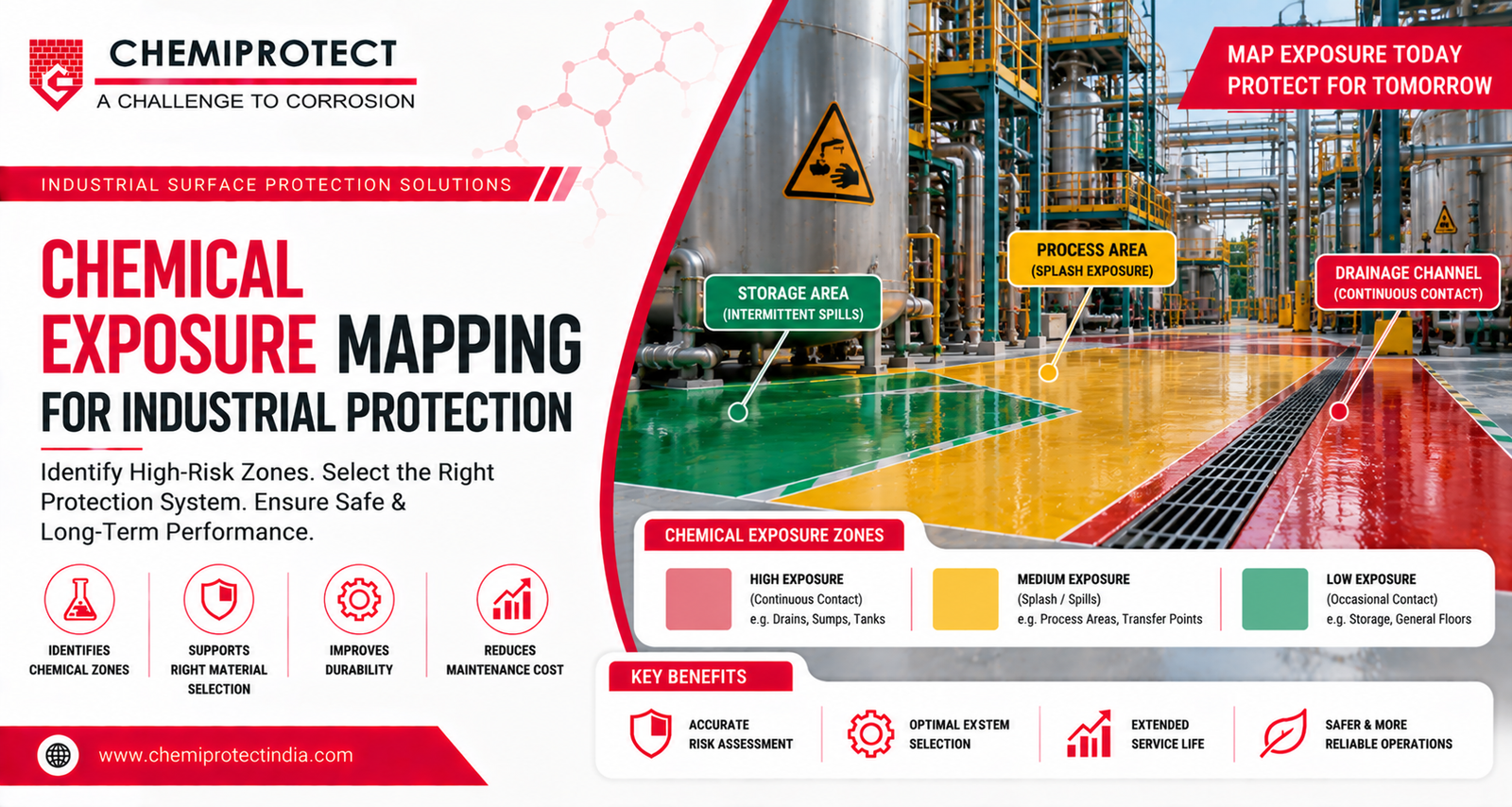
Chemical Exposure Mapping for Industrial Protection
October 6, 2026
What Is Chemical Exposure Mapping? Industrial
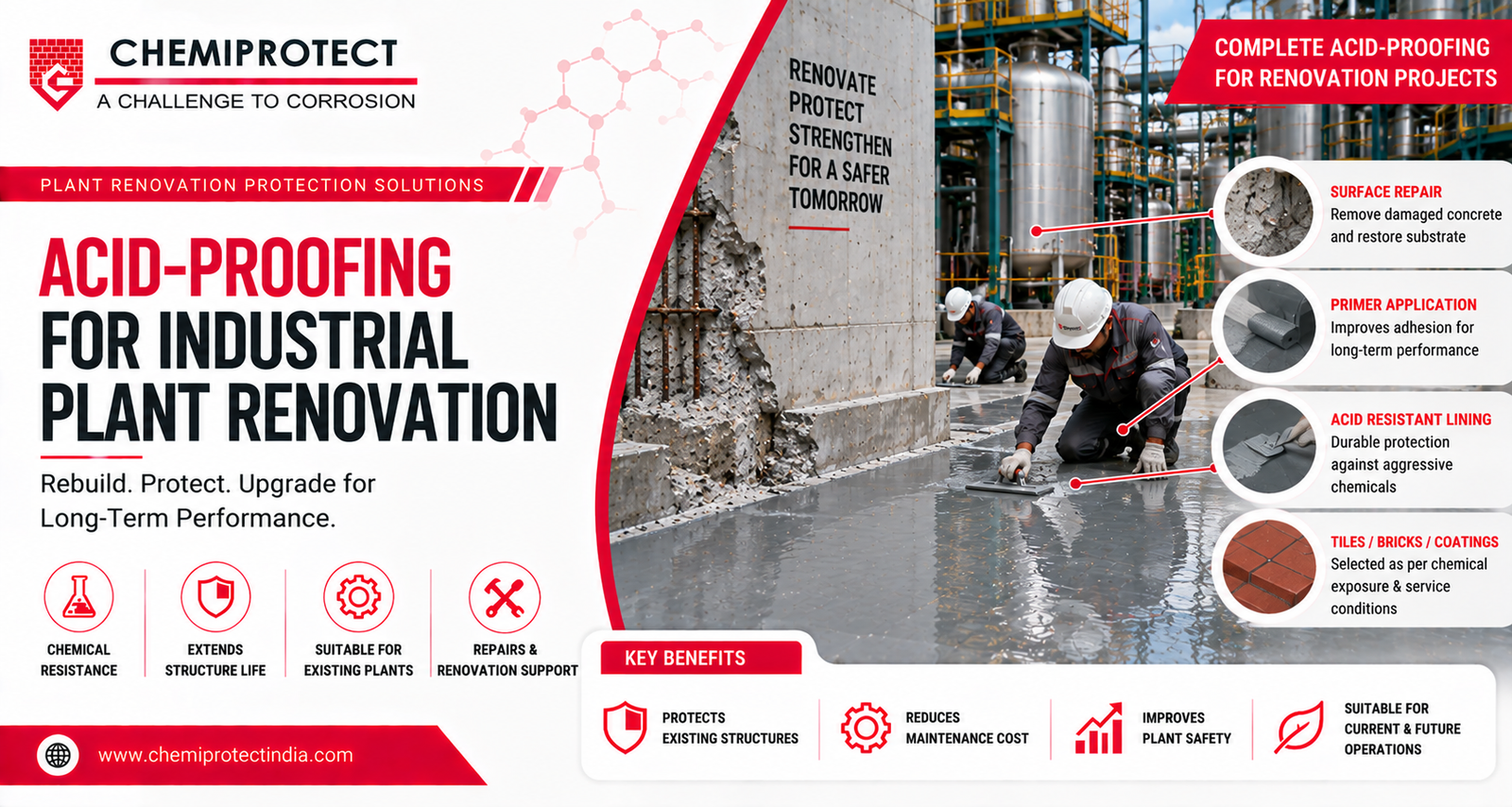
Acid-Proofing for Industrial Plant Renovation
October 3, 2026
Why Acid-Proofing Needs a Renovation-Specific Approach