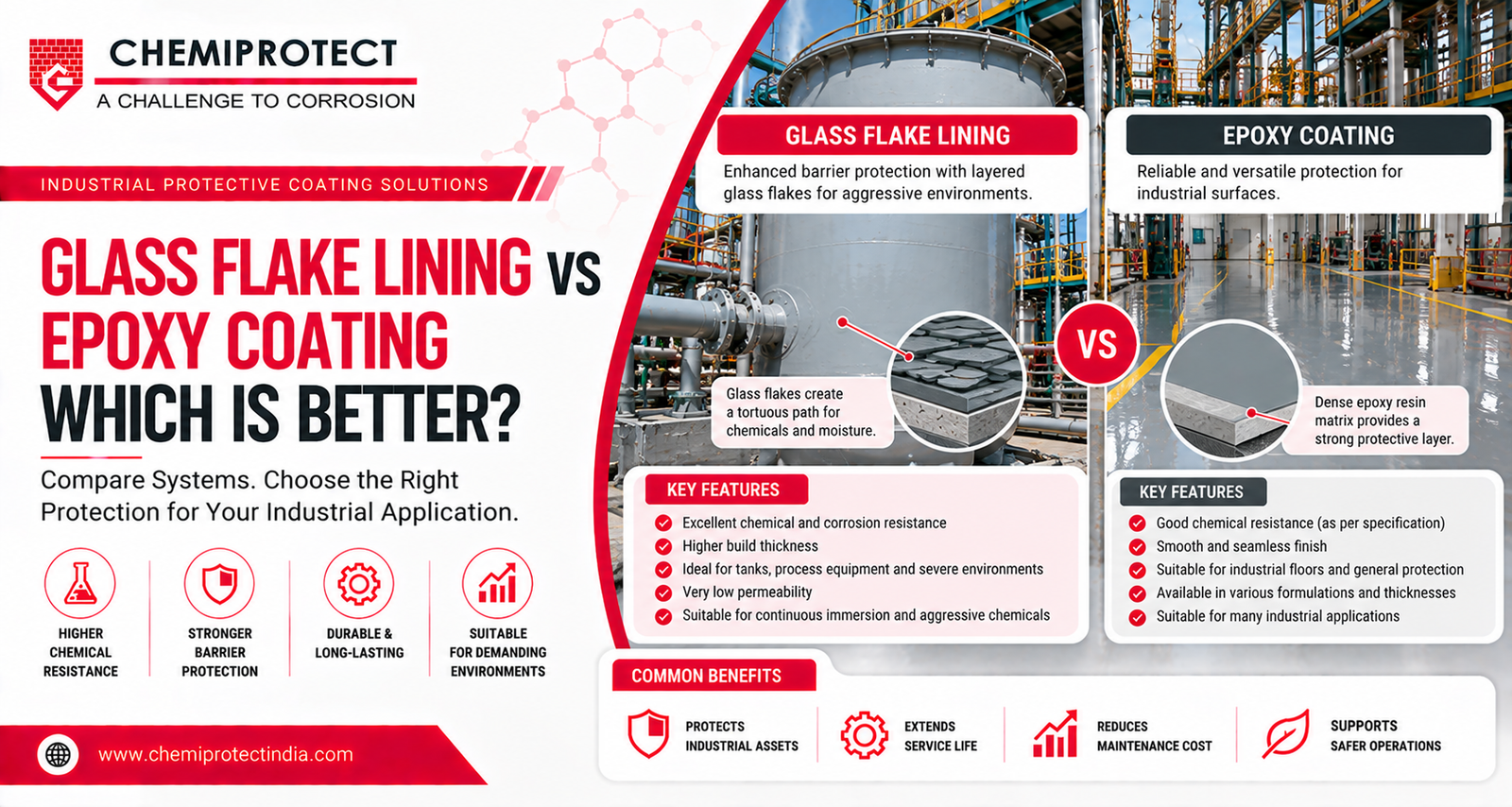
Glass Flake Lining vs Epoxy Coating: Which Protection System Fits Your Application?
Understanding Glass Flake Lining and Epoxy
Choosing the right protective system for an industrial surface is rarely as simple as selecting a product described as “chemical resistant.” Different chemicals can affect materials differently, and concentration, temperature, exposure duration, moisture, and abrasion can change the performance required. A chemical resistance chart helps engineers and plant teams move from a general product category to a more informed compatibility check.
A chemical resistance chart should therefore be treated as a technical selection aid, not a standalone guarantee of performance. Chemiprotect technical resources cover chemical resistance, product data, installation guidance, and detail drawings for specification and system selection.
A chemical resistance chart is a reference that indicates how a particular material or product performs when exposed to specified chemicals under defined conditions. Depending on the manufacturer and system, the chart may use ratings, codes, symbols, or descriptive terms to show the level of resistance.
The important point is that a chart relates a material to a particular exposure. It does not mean that one coating, mortar, tile lining, or resin system is universally resistant to every chemical environment. For industrial applications, the chart should be read alongside technical information and actual operating conditions.
Chemical attack can gradually compromise a substrate even when damage is not immediately visible. Liquids may penetrate through pores, joints, cracks, or other discontinuities and eventually affect concrete, steel, masonry, or other construction materials. Once the protective layer is unsuitable for the exposure, repairs can become disruptive and costly.
This is why selecting a chemical-resistant system begins with understanding the environment rather than starting with a product name. The same industrial area may experience chemical splashes, occasional spills, wash-down water, continuous immersion, or contact with process residues.
Start by identifying the exact chemical or chemical mixture and its operating concentration. Resistance can vary significantly between dilute and concentrated solutions, so simply identifying an acid, alkali, solvent, or salt is not always enough.
Temperature can influence chemical interaction and material performance. A system suitable for a particular chemical at ambient conditions may require a different evaluation when the process operates at elevated temperatures. Record normal operating temperature as well as expected temperature peaks.
Determine how the surface will encounter the chemical. Splash exposure, intermittent spills, continuous contact, and full immersion create different demands. Exposure duration also matters. A short accidental spill is not equivalent to a process tank that remains in contact with a chemical for extended periods.
Chemical exposure is only one part of the environment. Floors and process areas may also experience forklift traffic, dropped loads, abrasion, vibration, impact, or thermal movement. A chemically compatible material still needs to be suitable for the mechanical conditions.
The protective system must work with the substrate and construction. Concrete condition, surface preparation, joints, drains, corners, penetrations, and terminations can influence the performance of a lining or coating. This is especially important when selecting between seamless systems and layered or tiled lining arrangements.
Begin by locating the chemical in the chart and identifying the relevant concentration and temperature range. Next, check the product or system grade being considered and note the manufacturer’s resistance rating or code.
Do not stop at a single “resistant” indication. Review the notes, limitations, and definitions associated with the rating. Some charts distinguish between continuous and intermittent exposure, while others provide classifications that need to be interpreted using technical documentation.
It is also important to check whether the chart applies to the exact product grade. Resin chemistry, reinforcement, formulation, curing conditions, and system thickness can differ between products that appear similar at a broad category level.
Once compatibility has been reviewed, the next step is to determine what type of protection system fits the application. Depending on the exposure, industrial protection may involve chemical-resistant mortar, acid-resistant brick or tile lining, epoxy systems, glass-flake reinforced coatings, polyurethane products, or a combination of components.
For example, a tiled lining may be considered where a hard, chemically resistant wearing surface is required, while a seamless resin-based system may be more suitable where continuous coverage around complex geometry is important. The selection depends on the operating environment and protective assembly.
The system should be considered as a complete construction rather than an isolated material. Primer, membrane or interliner, bedding and jointing material, facing material, and substrate preparation may each contribute to finished performance. Chemiprotect’s acid and alkali resistant mortars, epoxy products, glass-flake products, and acid-resistant bricks and tiles illustrate why system-level evaluation matters.
One common mistake is selecting a material solely because the chemical appears in a resistance table. The table should be considered together with concentration, temperature, exposure duration, and mechanical conditions.
Another mistake is overlooking joints and detailing. Even when the exposed material has appropriate chemical resistance, weak transitions, penetrations, drains, or poorly prepared surfaces can become vulnerable points.
A third mistake is comparing products only by chemical resistance. Installation requirements, substrate compatibility, curing, thickness, traffic, cleaning practices, and maintenance conditions may also affect whether a system is appropriate.
A structured process can make chemical compatibility evaluation easier. First, create an exposure list for the area and record each chemical, concentration, temperature, and exposure pattern. Second, identify the substrate and document its current condition. Third, use the relevant chemical resistance chart to shortlist technically compatible materials
Next, compare the shortlisted systems against mechanical and installation requirements. Review the complete system design, including primers, membranes, mortars, joints, and surface layers where applicable. Finally, confirm the selection against current technical documentation and project-specific conditions before installation.
This approach helps prevent a common specification problem: choosing a product that is chemically compatible in isolation but unsuitable for the complete operating environment.
A chemical resistance chart provides valuable technical guidance, but industrial projects often involve multiple simultaneous stresses. A production floor may face chemicals, moisture, traffic, impact, cleaning procedures, and temperature changes. A tank or process area may have prolonged chemical contact and different substrate requirements.
For this reason, project teams should use manufacturer documentation as part of a broader engineering assessment. Chemiprotect Engineers’ technical resources include chemical resistance information alongside product data sheets, safety information, installation guidance, brochures, and detail drawings, helping teams evaluate the protection system more broadly.
Using a chemical resistance chart effectively means looking beyond a simple yes-or-no compatibility check. Chemical identity, concentration, temperature, exposure pattern, mechanical conditions, substrate, and construction details all influence the suitability of an industrial protection system.
A disciplined evaluation can help engineers narrow the available options and avoid selecting a material based on chemical name alone. When the chart is combined with product documentation, system design, and project-specific assessment, it becomes a practical tool for specifying durable chemical protection.
For industrial facilities dealing with aggressive chemical environments, exploring chemical-resistant solutions and technical resources can be a useful next step for project teams evaluating suitable systems for demanding applications.
When used with chemical resistant masonry units and the proper membrane MIPRO-VE will protect concrete and steel sub base from chemical attacks and physical abuse. MIPRO-VE is silica filled vinyl ester mortar supplied in two parts .
Understanding Glass Flake Lining and Epoxy
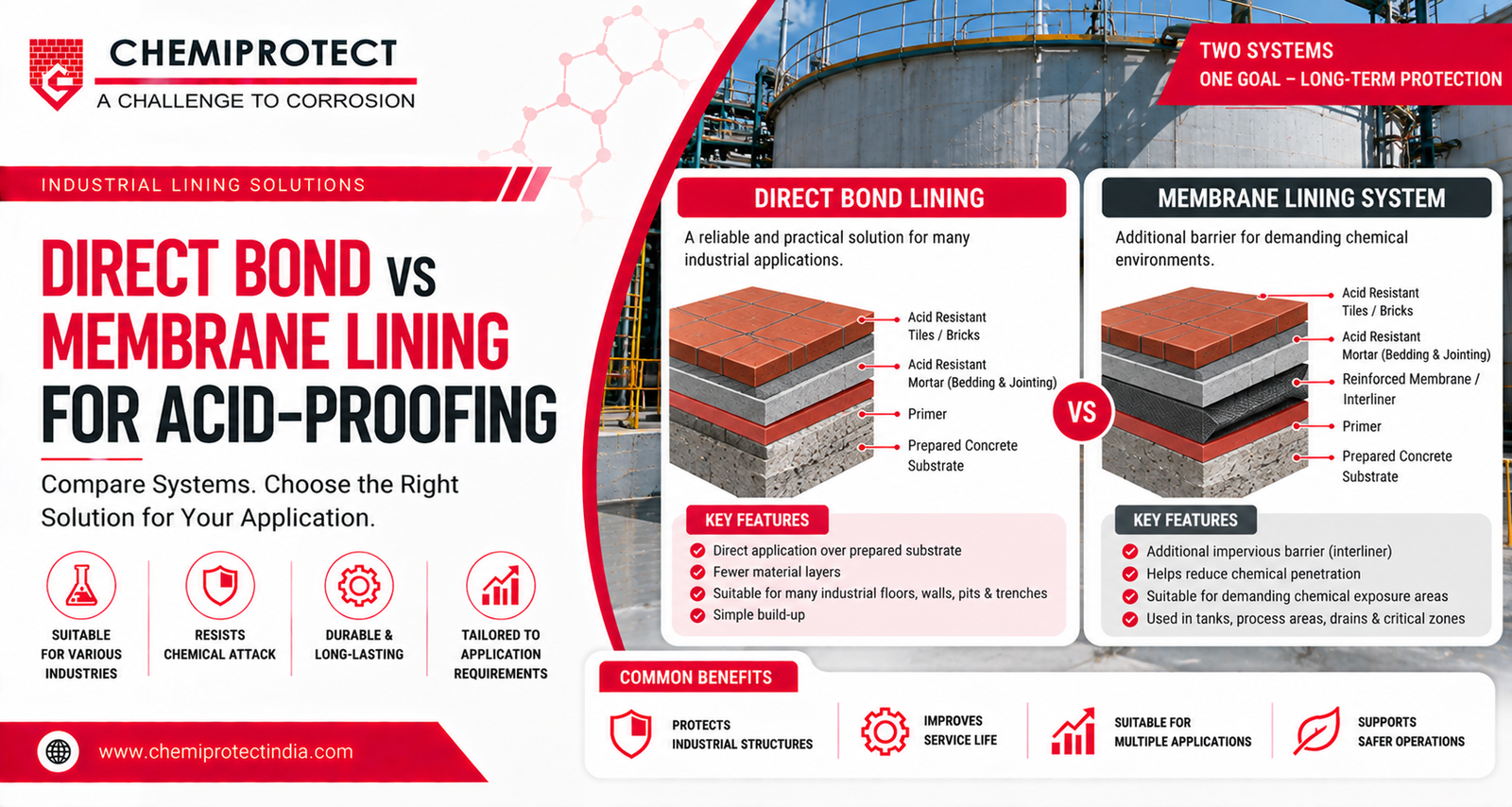
Understanding the Difference Between Direct Bond
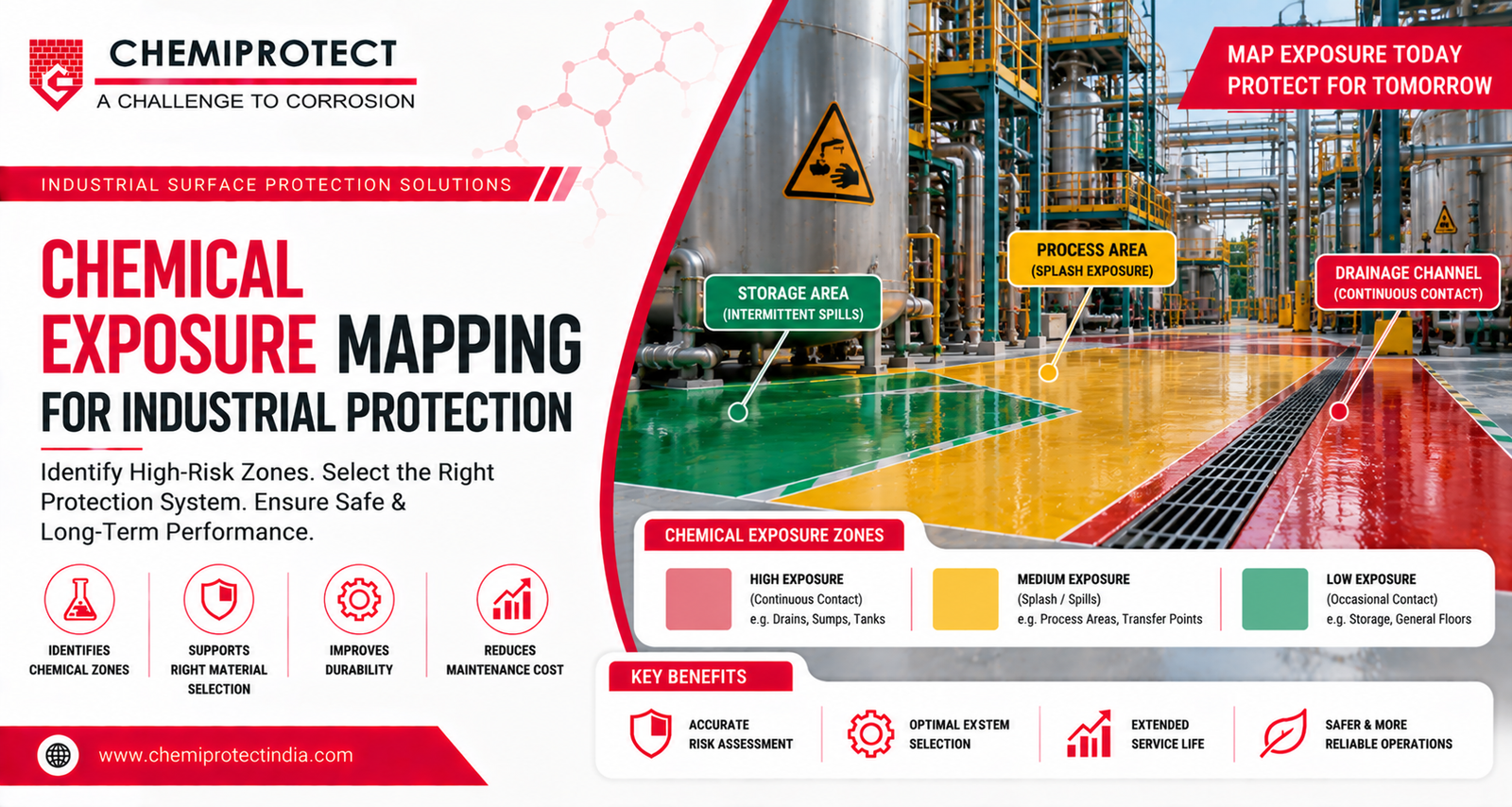
What Is Chemical Exposure Mapping? Industrial
Connect Now