Industrial Concrete Repair for Chemical Exposure
Industrial Concrete Repair for Chemical Exposure
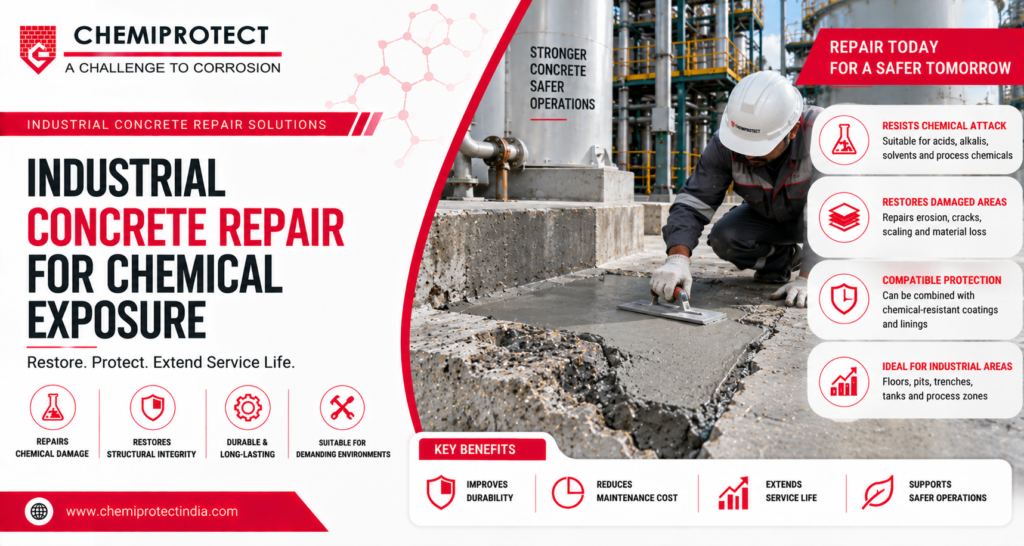
Industrial concrete can deteriorate when exposed to acids, alkalis, process chemicals, contaminated water, cleaning agents, and other aggressive substances. Damage may appear as erosion, cracking, scaling, material loss, or deterioration around joints and equipment bases. Repair should also address the source of chemical exposure. Industrial Concrete Protection Solutions.
can support a broader approach that combines concrete repair with chemical-resistant protection suited to the operating environment.
What Is Industrial Concrete Repair for Chemical Exposure?
Industrial concrete repair for chemical exposure involves restoring damaged concrete and preparing the structure for continued service in an aggressive environment. The repair may include removing deteriorated material, rebuilding damaged sections, treating cracks or joints, and applying a compatible protective coating or lining.
The repair strategy should be based on the cause and severity of deterioration. Chemical attack, moisture, abrasion, impact, thermal cycling, and structural movement can all contribute to damage. A repair that addresses only the surface without considering continuing exposure may have a limited service life.
Why Does Chemical Exposure Damage Concrete?
Concrete contains cementitious materials that can be affected by certain aggressive chemicals. When corrosive liquids remain on a surface or penetrate through cracks and pores, they may react with components of the concrete and gradually weaken the material.
Repeated exposure can be especially challenging in industrial areas where spills, washing, immersion, and process liquids occur regularly. Once the surface becomes damaged, chemical penetration may become easier, creating a cycle of deterioration if the area is not properly repaired and protected.
Common Signs of Chemical Damage in Industrial Concrete
Surface Erosion and Softening
Chemical exposure can cause loss of surface material, roughness, or localized softening. These conditions may become more noticeable in areas where liquids collect or where cleaning is frequent.
Cracking and Joint Deterioration
Cracks and damaged joints can provide pathways for liquids to reach deeper into the structure. Movement, temperature changes, settlement, and mechanical loading may increase the problem.
Scaling and Material Loss
Repeated chemical or physical exposure can lead to scaling and loss of the concrete surface. Areas near drains, sumps, process equipment, and chemical transfer points may be particularly vulnerable.
Damage Around Equipment and Penetrations
Equipment bases, pipe penetrations, corners, and transitions can concentrate chemical exposure and mechanical stress. These details often require specific repair and protection measures.
Where Is Chemical-Exposed Concrete Commonly Repaired?
Chemical Processing Facilities
Floors, bunds, trenches, pits, and equipment foundations may require repair after exposure to acids, alkalis, solvents, and process liquids.
Effluent and Wastewater Areas
Treatment areas, drainage channels, sumps, and collection pits can experience aggressive wastewater and prolonged moisture exposure. Repair systems should be compatible with the expected liquid conditions.
Pharmaceutical, Food, and Beverage Plants
Frequent cleaning, sanitation, moisture, and chemical agents can affect industrial floors and drainage areas. Repairs should provide a suitable base for continued hygiene and chemical resistance.
Battery and Electroplating Facilities
Battery-related operations and electroplating processes can involve corrosive substances. Damaged concrete in handling and processing zones may require repair followed by a suitable chemical-resistant surface.
Key Steps in Industrial Concrete Repair
Assess the Extent of Damage
The first step is to identify damaged areas and understand why deterioration occurred. Surface condition, cracks, joints, moisture, contamination, chemical exposure, and mechanical stresses should be reviewed before selecting repair materials.
Remove Unsound Concrete
Loose, weak, or chemically deteriorated concrete may need removal until a sound substrate is reached. The repair boundary should suit rebuilding and the selected repair material.
Prepare and Repair the Substrate
The exposed surface should be cleaned and prepared according to the repair system. Suitable repair mortars or compatible materials may rebuild lost sections and restore the required profile.
Apply Chemical-Resistant Protection
After repair, the surface may require a protective coating or lining to reduce renewed chemical exposure. Epoxy, polyurethane, glass-flake, tile, brick, and chemical-resistant mortar systems can be considered according to service conditions. Chemical Resistant Coating and Lining Services.
Choosing the Right Repair Material
Match the Chemical Exposure
Identify the acids, alkalis, salts, solvents, cleaning chemicals, or wastewater that may contact the repaired area. Concentration, temperature, exposure duration, and frequency should be considered when evaluating compatibility.
Consider Mechanical Conditions
Industrial floors may face forklifts, impact, abrasion, heavy loads, vibration, and thermal cycling. The repair and protective system should have suitable performance for these physical stresses.
Check Moisture and Substrate Conditions
Moisture, surface profile, cracks, existing coatings, and concrete condition can influence material selection and installation. These factors should be assessed before application.
Design the Repair and Protection Together
Repair should not be treated as a separate task from protection. A sound repair provides the foundation for the protective system, while the protective system helps limit renewed chemical attack.
Importance of Joint and Detail Treatment
Joints, corners, drains, penetrations, equipment bases, and changes in level can become vulnerable points after repair. These areas should be detailed so that the protective layer remains continuous and movement can occur where the structure requires it.
Expansion joints should remain capable of movement rather than being filled with an unsuitable rigid repair material. Where chemical exposure is significant, joint sealants and surrounding materials should be selected for compatibility with the complete system.
Installation Quality Matters
Repair materials can perform poorly if applied over contaminated, weak, or unsuitable surfaces. Preparation, mixing, application thickness, curing, joint treatment, and protection during curing should follow the selected system requirements.
Technical documentation, product data sheets, installation instructions, and chemical resistance information can help engineers and plant teams plan repairs and protective systems. Technical Resources for Industrial Protection.
Preventing Repeated Concrete Damage
Repair is most effective when the source of deterioration is also addressed. Facilities should review spill control, drainage, cleaning, chemical storage, process leaks, and surface protection.
Where repeated exposure is expected, a chemical-resistant lining or coating can provide an additional barrier. Regular inspection can identify small defects before they become larger problems.
Why Choose Chemiprotect Engineers?
Chemiprotect Engineers has been developing acid-proofing and corrosion-resistant solutions since 1970. Its range includes acid and alkali resistant mortars, epoxy, glass-flake, polyurethane, acid-resistant bricks and tiles, waterproofing products, and construction chemicals.
The company serves chemical processing, pharmaceuticals, fertilizers, electroplating, battery manufacturing, food, beverage, power, steel, petroleum, pulp and paper, and other industrial sectors. Its approach considers repair and protection requirements around actual operating conditions.
Conclusion
Industrial concrete repair for chemical exposure requires more than restoring damaged concrete. The repair should address substrate condition, deterioration causes, chemicals involved, and physical stresses.
Industrial concrete repair for chemical exposure requires more than restoring damaged concrete. The repair should address substrate condition, deterioration causes, chemicals involved, and physical stresses.
For industrial facilities dealing with chemical attack and concrete deterioration, explore Chemiprotect’s industrial protection solutions.
to review approaches for concrete protection, acid-resistant linings, chemical-resistant coatings, and related industrial surface protection.
FAQs
1. What is industrial concrete repair for chemical exposure?
It is the process of repairing damaged concrete and restoring it with compatible protective systems for aggressive chemical environments.
2. What are the common signs of chemical damage in concrete?
Surface erosion, softening, cracks, joint deterioration, scaling, material loss, and damage around equipment bases are common indicators.
3. Where is chemical-damaged concrete commonly repaired?
Repairs are common in chemical plants, wastewater facilities, pharmaceutical and food industries, battery manufacturing, and electroplating areas.
4. What are the key steps in industrial concrete repair?
The process includes damage assessment, removal of unsound concrete, substrate repair, and application of a chemical-resistant coating or lining.
5. How can repeated chemical damage be prevented?
Preventive measures include controlling spill sources, improving drainage, regular inspection, and using compatible chemical-resistant protective systems.
Let’s Blog
Latest Blog
When used with chemical resistant masonry units and the proper membrane MIPRO-VE will protect concrete and steel sub base from chemical attacks and physical abuse. MIPRO-VE is silica filled vinyl ester mortar supplied in two parts .
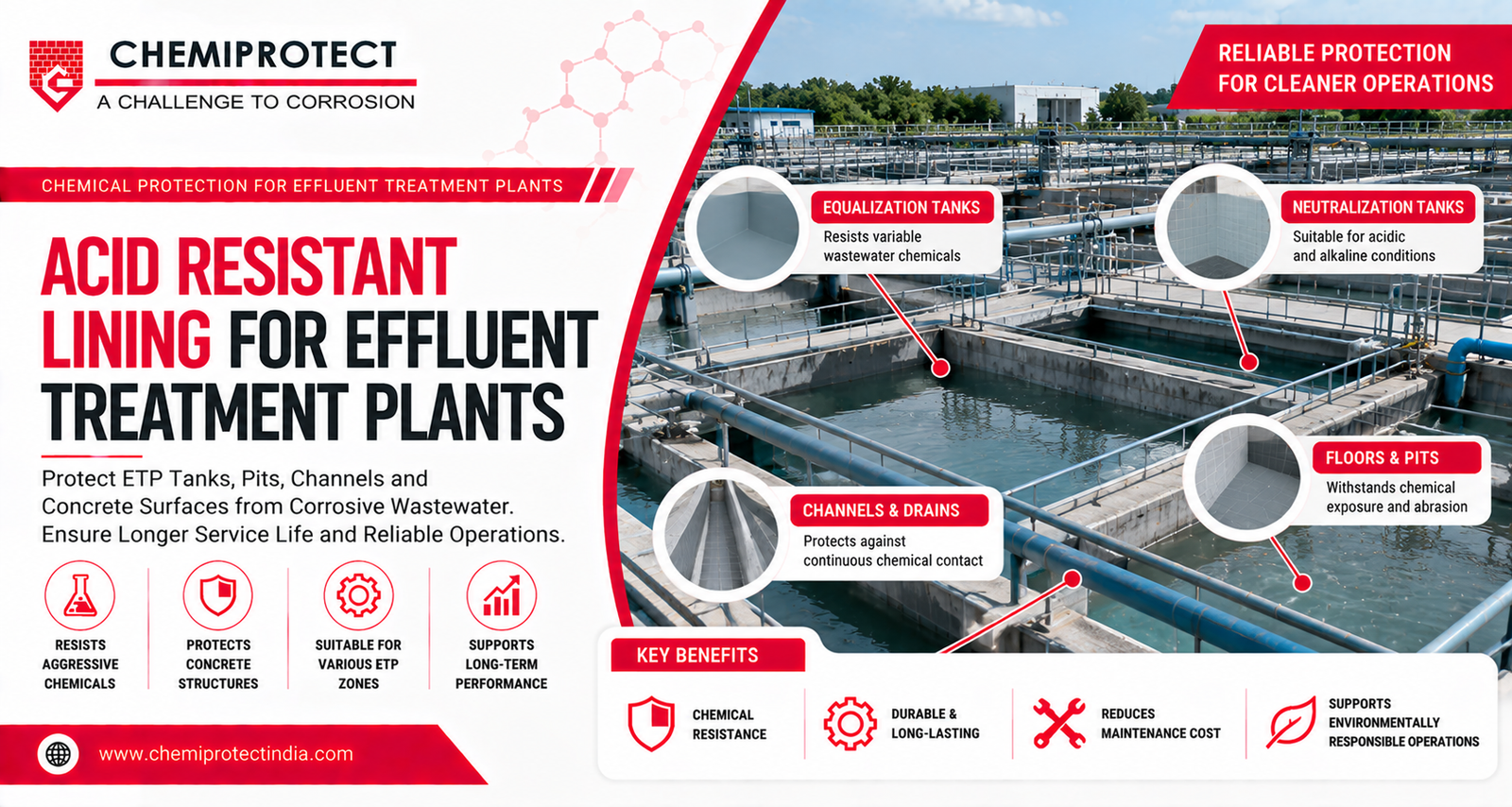
Acid Resistant Lining for Effluent Treatment Plants
October 18, 2026
Learn how acid resistant lining protects
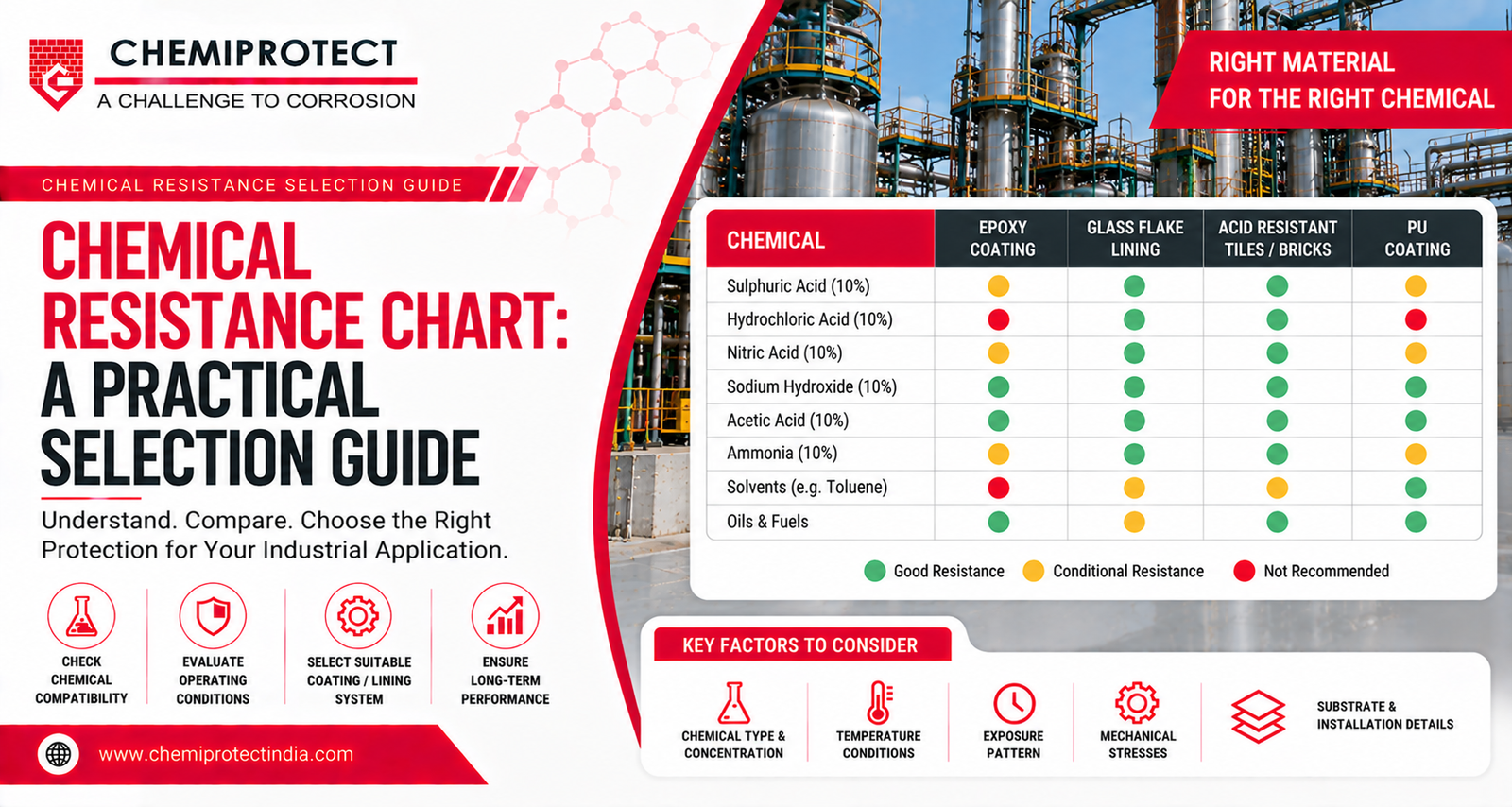
How to Read a Chemical Resistance Chart for Industrial Applications
October 15, 2026
Learn how to read a chemical