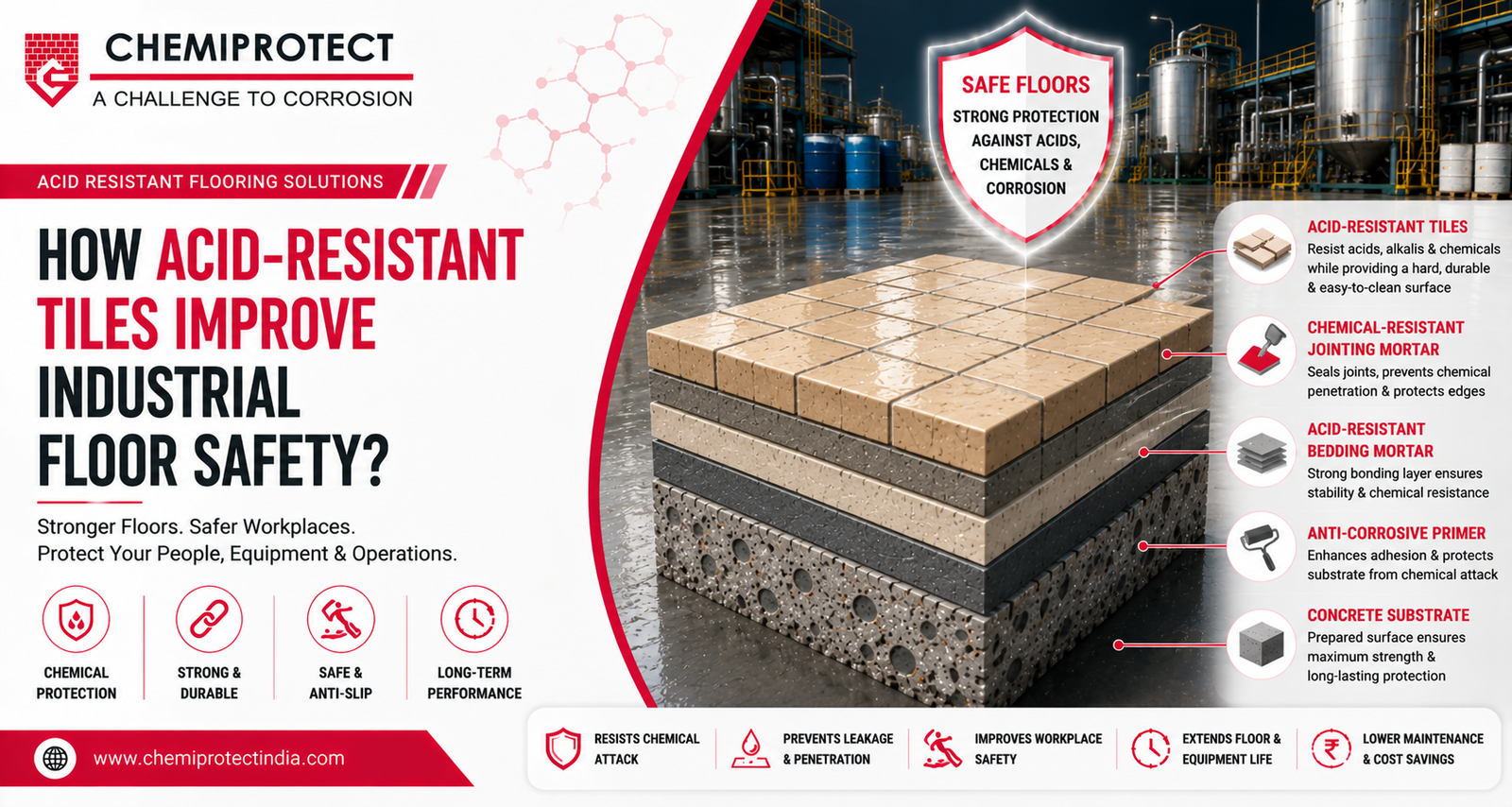
How Acid-Resistant Tiles Improve Industrial Floor Safety
Industrial floors can face demanding conditions
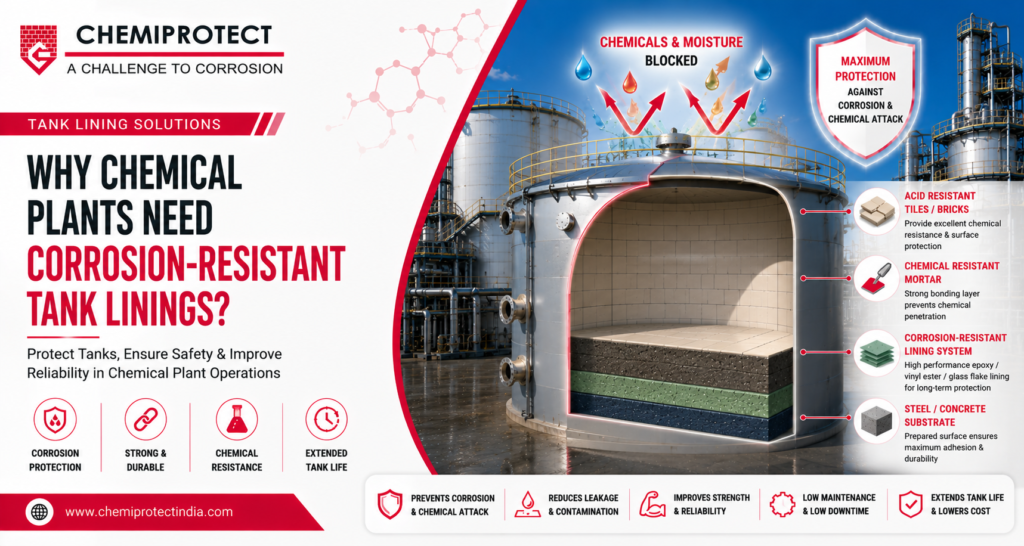
Chemical plants operate in environments where tanks, vessels and other industrial structures can be exposed to aggressive chemicals, moisture, temperature variations and physical wear. Without suitable protection, these conditions can affect the underlying steel or concrete and create long-term maintenance challenges.
Corrosion-resistant tank linings provide a protective barrier between the tank surface and the surrounding chemical environment. Chemiprotect’s industrial lining solutions include epoxy tank lining, glass flake and glass matt reinforced tank lining, as well as acid and alkali-resistant lining systems for demanding industrial applications.
Choosing the right lining is not simply about covering a tank surface. The chemical type, concentration, operating temperature, substrate, immersion conditions and expected service environment all need to be considered. A properly selected and applied lining can help protect the underlying structure and support longer service performance.
Chemical plants may handle acids, alkalis, solvents, process chemicals and other substances capable of attacking construction materials. Tanks can experience continuous or intermittent contact depending on how they are used.
When the underlying surface is exposed to corrosive substances, deterioration can occur over time. Steel surfaces may be affected by corrosion, while concrete can also be damaged when aggressive chemicals penetrate the surface.
Tank protection therefore needs to address the specific conditions of the application rather than relying on a standard paint or coating system.
A tank lining is a protective layer applied to the internal or external surface of a tank to help separate the substrate from the operating environment.
Chemiprotect provides several types of industrial lining systems, including epoxy flooring, coating, grouting and tank lining, as well as glass flake and glass matt reinforced coating and tank lining. Its services are designed for industrial environments where chemical resistance, corrosion protection and durability are important considerations.
The lining material can vary depending on the application. Epoxy, vinyl ester, polyester and glass-reinforced systems may be considered for different operating conditions.
The primary purpose of a protective lining is to create a barrier between the tank substrate and corrosive materials.
A properly selected lining can reduce direct contact between the chemical environment and the underlying steel or concrete. This helps protect the substrate from chemical attack.
Some high-performance lining systems are designed to resist the movement of aggressive substances through the protective layer. Chemiprotect’s MIPROGLASS 101 glass-flake coatings, for example, use graded glass flakes positioned parallel to the substrate to provide resistance to permeation and corrosion.
Industrial tanks may experience more than chemical exposure. Abrasion, physical impact and temperature changes can also affect protective surfaces. A suitable lining system can provide additional resistance according to the application’s requirements.
Tank lining requirements can vary significantly between chemical plants. Understanding the operating environment is essential before selecting a system.
Tanks exposed to acids, alkalis and other aggressive chemicals require a lining compatible with the substances being handled.
Some tanks remain in continuous contact with chemicals or liquids. In such applications, the lining needs to be selected for the expected immersion conditions.
Operating temperature can influence material selection. Certain industrial coating systems are designed to withstand specific temperature conditions.
Tanks and process equipment may also experience mechanical wear. Where abrasion is expected, the lining system should be evaluated for the required resistance.
The appropriate lining should always be selected according to the actual operating environment.
Not every lining material provides the same resistance to every chemical. Chemical type, concentration, temperature and exposure duration can all influence the suitability of a lining system.
Chemiprotect’s MIPROGLASS 101 range includes different resin systems, including isophthalic polyester, bisphenol polyester, vinyl ester, superior-grade vinyl ester and epoxy formulations. The company states that chemical resistance information should be checked for the appropriate grade before selection.
This makes chemical compatibility an important part of the specification process.
A coating that performs well in one chemical environment may not necessarily be the right choice for another.
Glass flake reinforced coatings can be considered for demanding corrosion-protection applications. Chemiprotect’s MIPROGLASS 101 system is described as a range of polyester, vinyl ester and epoxy resin-based coatings designed to protect steel and concrete against atmospheric corrosion and tank or process-plant exposure to chemical splashing and spillage.
The glass flakes within the coating lie parallel to the substrate. According to the product documentation, this construction provides resistance to permeation, corrosion, abrasion, physical abuse and thermal shock.
Such characteristics can make glass flake systems suitable for selected industrial environments where conventional surface protection may not provide the required performance.
Chemical plants may require lining systems specifically designed for acid and alkali exposure. Chemiprotect provides acid- and alkali-resistant brick, tile and stone lining systems for chemically aggressive environments.
Its acid-resistant tiles are designed for chemical industries, laboratories and other high-risk environments and are used as part of acid/alkali-resistant lining systems.
The company’s lining design can incorporate acid-resistant tiles or bricks, chemical-resistant bedding and jointing mortar, anti-corrosive primer and a concrete substrate. This creates a layered protection system rather than relying on a single surface material.
The appropriate system depends on the chemical exposure and project requirements.
Even a high-performance lining system needs a properly prepared substrate. Dust, oil, grease, loose material, weak concrete or unsuitable surface conditions can affect adhesion and contribute to premature coating failure.
Before lining application, the surface should be assessed and prepared according to the requirements of the selected system.
Contaminants such as oil, grease, dust and loose particles should be removed.
Cracks, damaged areas and other substrate problems should be addressed before applying the lining.
Primer selection, coating thickness, number of coats and curing conditions should follow the specified system.
Proper preparation is particularly important for tank lining because the coating must remain bonded to the substrate under the expected service conditions.
A suitable lining can help reduce direct chemical attack on the underlying tank surface. This can support the overall durability of the structure and help reduce avoidable maintenance problems.
However, lining should not be treated as a one-time solution that eliminates inspection. Industrial surfaces should still be checked regularly for cracks, damage, wear, leaks or other signs of deterioration.
Early identification of coating or lining damage can allow corrective action before the underlying substrate experiences more extensive exposure.
Regular inspection is especially important in areas with aggressive chemicals, continuous immersion or heavy industrial activity.
Corrosion-resistant lining systems can be relevant across many industries where chemicals or demanding operating conditions are present.
Chemiprotect serves industries including agro-chemicals, electroplating, pharmaceuticals, pulp and paper, chloro-alkali, soda ash, heavy chemicals, fertilizers, petroleum, steel and metal refineries.
Different industries may have very different requirements. A pharmaceutical facility may prioritise cleanable and chemically resistant surfaces, while a heavy chemical plant may require protection against aggressive chemical exposure and temperature conditions.
This is why tank lining selection should always begin with the actual service environment.
Selecting a corrosion-resistant tank lining requires an understanding of the complete application.
Consider:
Technical product data and chemical resistance information should be reviewed before selecting a system. Chemiprotect provides product data sheets, chemical resistance information, installation guidance and other technical resources to support project decisions.
A properly specified system can provide a more reliable approach to long-term corrosion protection.
Chemical plants need corrosion-resistant tank linings because tanks can face continuous exposure to chemicals, moisture, temperature changes and physical wear. Without suitable protection, the underlying steel or concrete can become vulnerable to deterioration.
A properly selected lining creates a protective barrier and can help resist chemical exposure, permeation, corrosion and other forms of surface damage. Glass flake reinforced systems, epoxy linings and acid-resistant tile or brick systems can each have applications depending on the operating environment.
The right choice should always be based on chemical compatibility, temperature, substrate, immersion conditions and application requirements rather than selecting a coating based on its name alone.
Chemiprotect Engineers has been providing acid-proofing and corrosion-resistant solutions since 1970 and offers epoxy, PU, glass flake reinforced and acid/alkali-resistant lining systems for industrial applications.
To explore available solutions, view Chemiprotect’s industrial lining and coating services. You can also contact Chemiprotect Engineers to discuss your tank protection requirements and identify a suitable corrosion-resistant lining system.
With proper material selection, surface preparation, application and maintenance, corrosion-resistant tank linings can play an important role in protecting industrial infrastructure and supporting reliable plant operations.
Tank linings create a protective barrier that helps protect steel and concrete surfaces from chemical exposure, corrosion, permeation, moisture, and physical wear.
It is a protective layer applied to the internal or external surface of a tank to separate the substrate from aggressive chemical environments and improve durability.
Chemical exposure, continuous immersion, high operating temperatures, and abrasion or physical wear are the main conditions that require specialized tank linings.
Different chemicals, concentrations, temperatures, and exposure durations require different resin systems, so compatibility must always be verified before selection.
Selection should be based on the tank substrate, chemical type and concentration, operating temperature, immersion conditions, abrasion, surface condition, and expected service life.
When used with chemical resistant masonry units and the proper membrane MIPRO-VE will protect concrete and steel sub base from chemical attacks and physical abuse. MIPRO-VE is silica filled vinyl ester mortar supplied in two parts .
Industrial floors can face demanding conditions
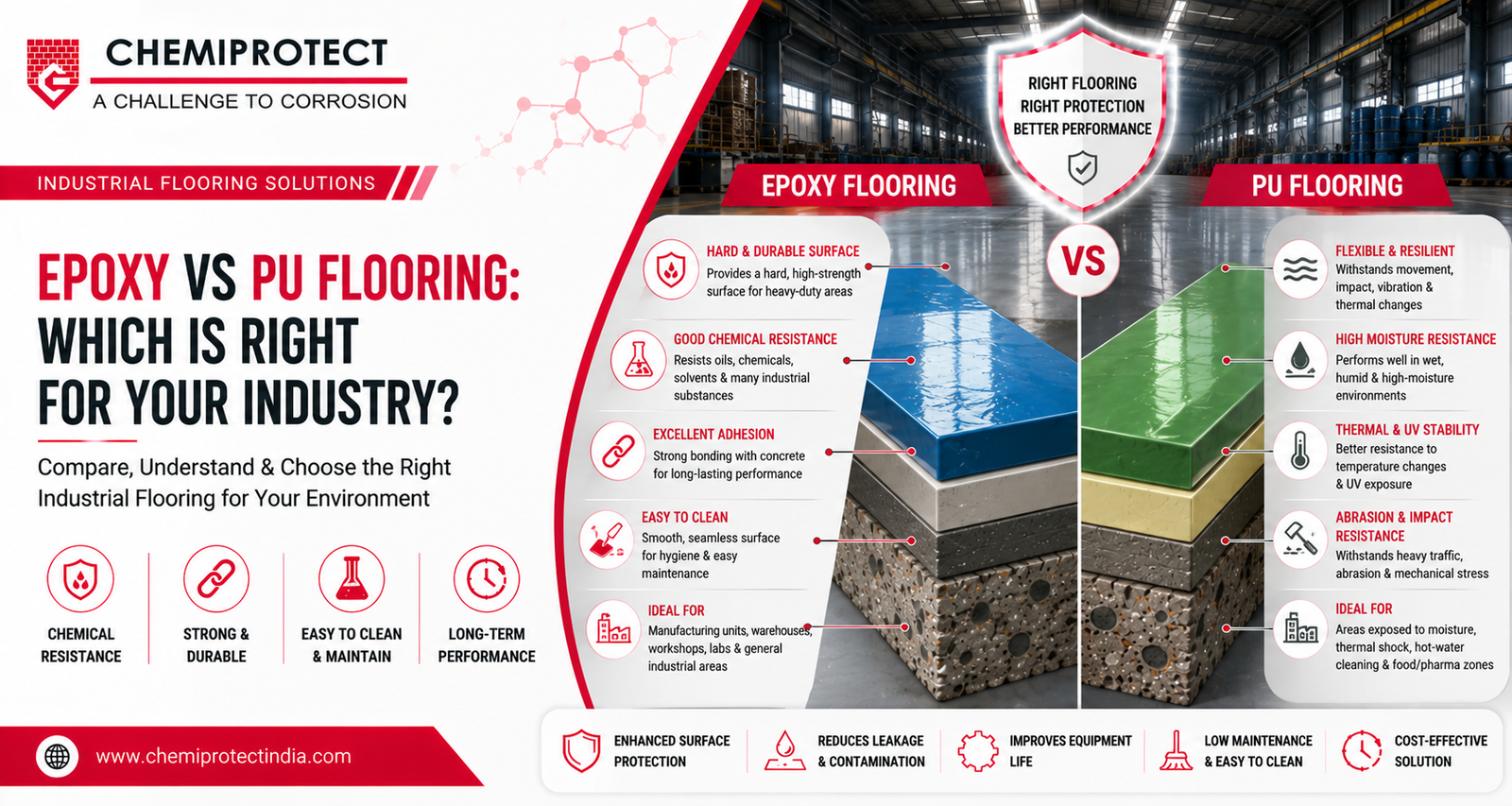
Industrial floors have to withstand much
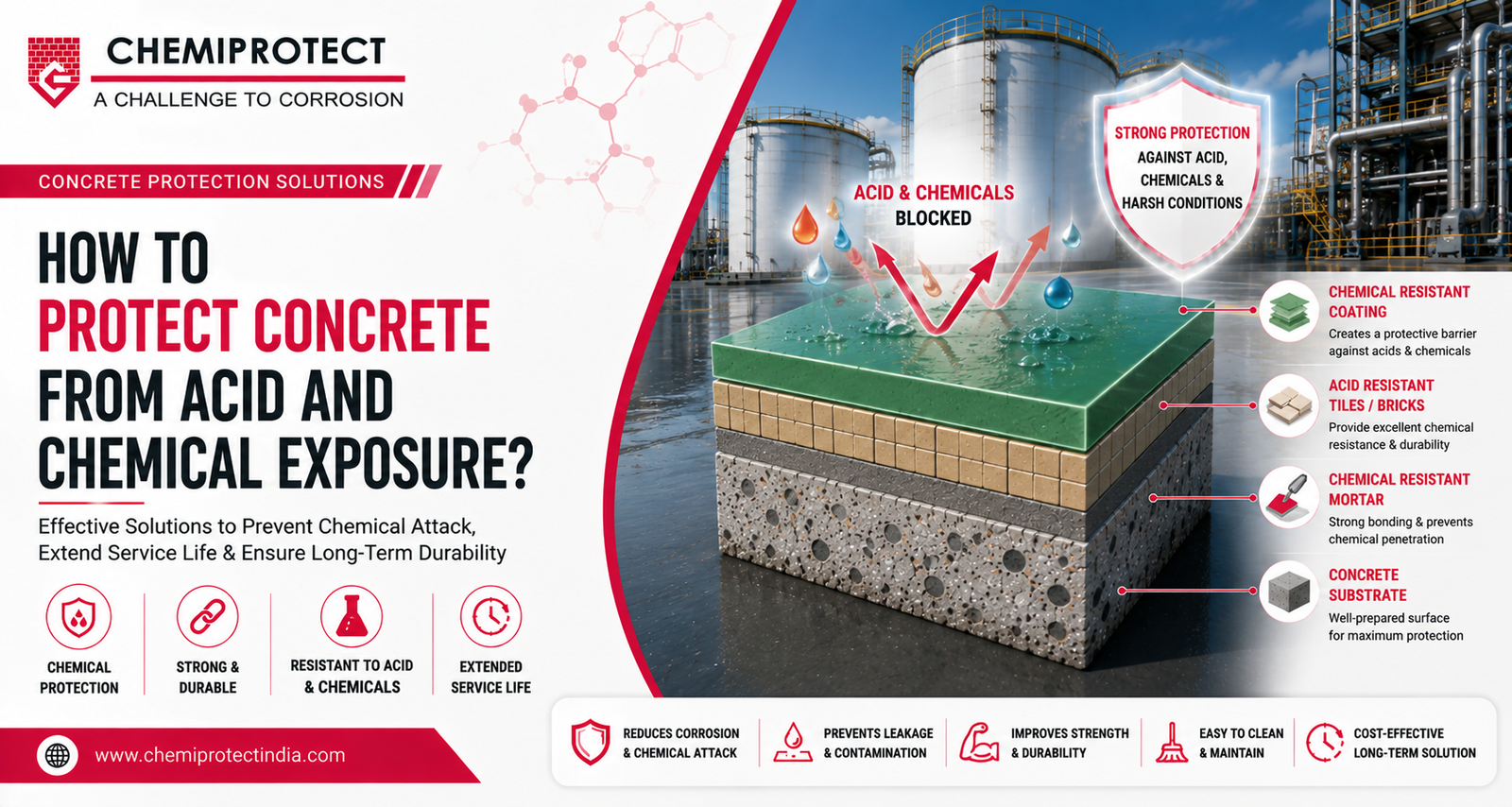
Concrete is widely used in industrial
Connect Now