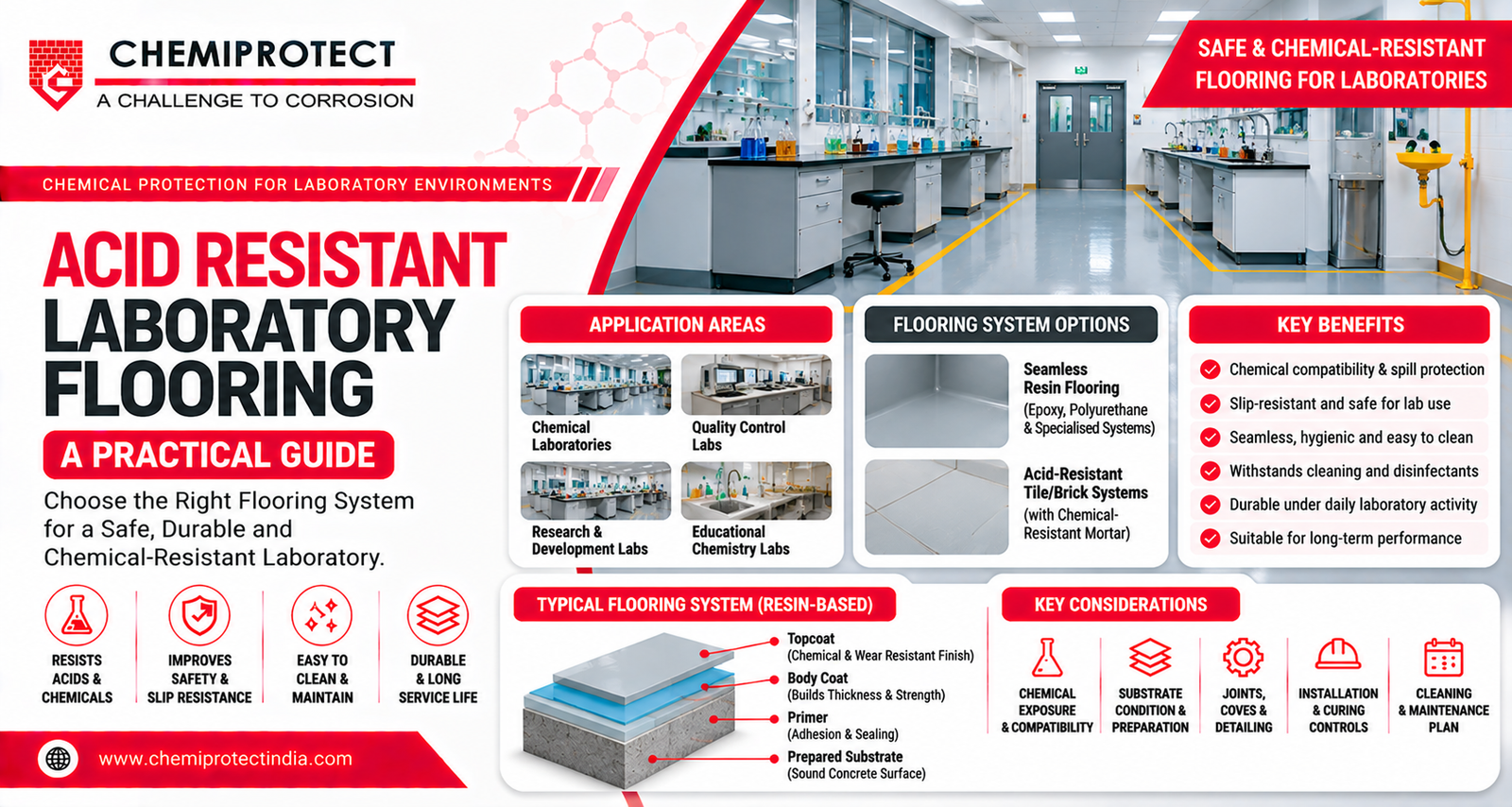
Acid Resistant Flooring for Laboratories: How to Choose the Right System
A guide to acid resistant laboratory
Industrial assets exposed to aggressive chemicals need protective systems selected for their specific service conditions. Vinyl ester resin coating is one technology considered in demanding corrosion-control applications because suitable formulations can offer a useful combination of chemical resistance, adhesion and mechanical performance. However, “vinyl ester” is not a universal performance guarantee. Resin chemistry, reinforcement, cure, film thickness, substrate preparation and exposure conditions all influence the result. Understanding these factors helps engineers decide where the technology may be appropriate. A review of industrial chemical protection solutions can help connect the selected surface system to the actual process environment.
Vinyl ester resins are thermosetting materials formed by reacting an epoxy resin with an unsaturated monocarboxylic acid, followed by dilution with a reactive monomer in many commercial formulations. During curing, the material forms a cross-linked polymer network. The resulting coating or lining can be formulated for industrial protection, including environments where chemical exposure is a major design concern. The suitability of industrial corrosion protection should be confirmed against the site’s actual operating conditions.
The final performance depends on the specific resin and formulation. Different grades may be designed for different acids, alkalis, solvents, temperatures or application methods. Fillers, pigments and glass flake reinforcement can alter barrier and mechanical characteristics. For this reason, a product data sheet and chemical resistance schedule are more useful than relying on the generic resin-family name.
One reason vinyl ester systems are evaluated is their potential to resist a range of corrosive environments when correctly formulated and cured. In suitable applications, they can help protect concrete or metal substrates from chemical attack and reduce the rate at which corrosive media reach the underlying structure. Reinforced versions may provide additional barrier characteristics for selected service conditions.
These coatings can be considered for tanks, bunds, process areas, ducts, scrubber components and other assets where the design calls for a protective lining. The suitability of each application must be assessed individually. Concentration, temperature, immersion, abrasion, vapour exposure and cleaning chemicals can change the performance requirement significantly. Never transfer approval from one application to another without checking the conditions.
Chemical compatibility should be assessed using the exact substance, concentration and temperature expected in service. Some environments involve mixtures, contaminants or changing concentrations during production. A material may tolerate intermittent splashes but not continuous immersion, or may perform differently when exposed to elevated temperature. Ask for resistance information that reflects the intended exposure and clarify the limits of the available data. Review the available vinyl ester coating products against the specified exposure before finalising the design.
Also assess the entire system rather than only the resin. Primers, fillers, reinforcement, topcoats, joint sealants and repair materials may have different chemical limits. If the coating is applied over concrete, moisture and alkalinity may influence preparation and adhesion. For steel, corrosion condition and surface profile matter. A technically suitable resin can fail when an incompatible accessory or weak interface becomes the route for chemical ingress.
Some industrial vinyl ester coatings incorporate glass flakes. The flakes are distributed through the resin and can create a more tortuous path for permeating liquids when the system is properly formulated and applied. This can be useful in selected corrosion-protection applications, but performance depends on flake geometry, orientation, resin content, thickness, cure and workmanship.
Glass flake products are not automatically suitable for every tank or process area. Evaluate whether the substrate, operating temperature, chemical exposure and application method are compatible with the product. Confirm the specified thickness and whether reinforcement is required at corners, welds or transitions. Chemiprotect’s [glass flake protection products] are relevant to review when considering this category of industrial coating.
Surface preparation is fundamental. Concrete should be sound and free from laitance, oil, dust and weak material. Cracks, voids and damaged areas should be repaired with compatible materials. Steel surfaces require removal of rust, mill scale, salts, oil and old coatings, followed by the cleanliness and profile specified by the coating manufacturer. Poor preparation can cause adhesion failure even when the resin itself is chemically suitable.
Application controls include correct component ratios, mixing, pot life, environmental conditions, wet and dry film thickness, recoat intervals and curing. Some resin systems have specific requirements for temperature and humidity. The applicator should follow the approved method statement and use suitable ventilation and personal protective equipment as stated in the safety data sheet. Avoid improvising with thinner or additives that are not approved.
Quality assurance should be planned before application begins. Define inspection hold points for substrate acceptance, primer, each coat and final cure. Depending on the system, checks may include surface profile, moisture, film thickness, adhesion and holiday testing. Record environmental readings, batch numbers and application times. The acceptance criteria should be agreed in the project specification rather than selected after installation.
Once in service, inspect for blistering, cracking, pinholes, discolouration, softening and mechanical damage. Review any changes in process chemistry or temperature before they are implemented. Repair damaged areas with an approved compatible procedure and verify the repair before returning the asset to service. A maintenance record helps identify recurring damage and informs future coating selection.
Start with a clear service description: substrate, chemical, concentration, temperature, exposure duration, abrasion, cleaning method and expected service life. Compare vinyl ester with other suitable technologies only after these conditions are defined. Consider whether a coating, reinforced lining, tiled lining or another construction detail is more appropriate for the asset geometry and operating risk.
Request written technical advice and supporting documentation from the manufacturer or specialist. Clarify product limitations, application conditions, curing requirements and inspection needs. Evaluate the installer’s experience with similar environments and whether the project allows adequate preparation and cure time. A complete system specification, supported by practical quality control, is the best basis for a durable result.
A common mistake is treating all vinyl ester formulations as interchangeable. Resin grade, reinforcement, curing conditions and the exact chemical exposure influence performance. Another is focusing on the resin while overlooking primers, joints, sealants and repair materials.
Avoid applying the system outside the specified temperature or humidity limits. Do not assume that glass flake reinforcement removes the need for correct preparation, thickness control and inspection.
Vinyl ester resin coating can be considered for selected industrial environments when the formulation and complete system are suited to the exposure. Confirm chemical compatibility, preparation, reinforcement, application controls and maintenance requirements before approval. For relevant industrial protection materials, visit the Chemiprotect Engineers website and request guidance using the actual service conditions.
When used with chemical resistant masonry units and the proper membrane MIPRO-VE will protect concrete and steel sub base from chemical attacks and physical abuse. MIPRO-VE is silica filled vinyl ester mortar supplied in two parts .
A guide to acid resistant laboratory
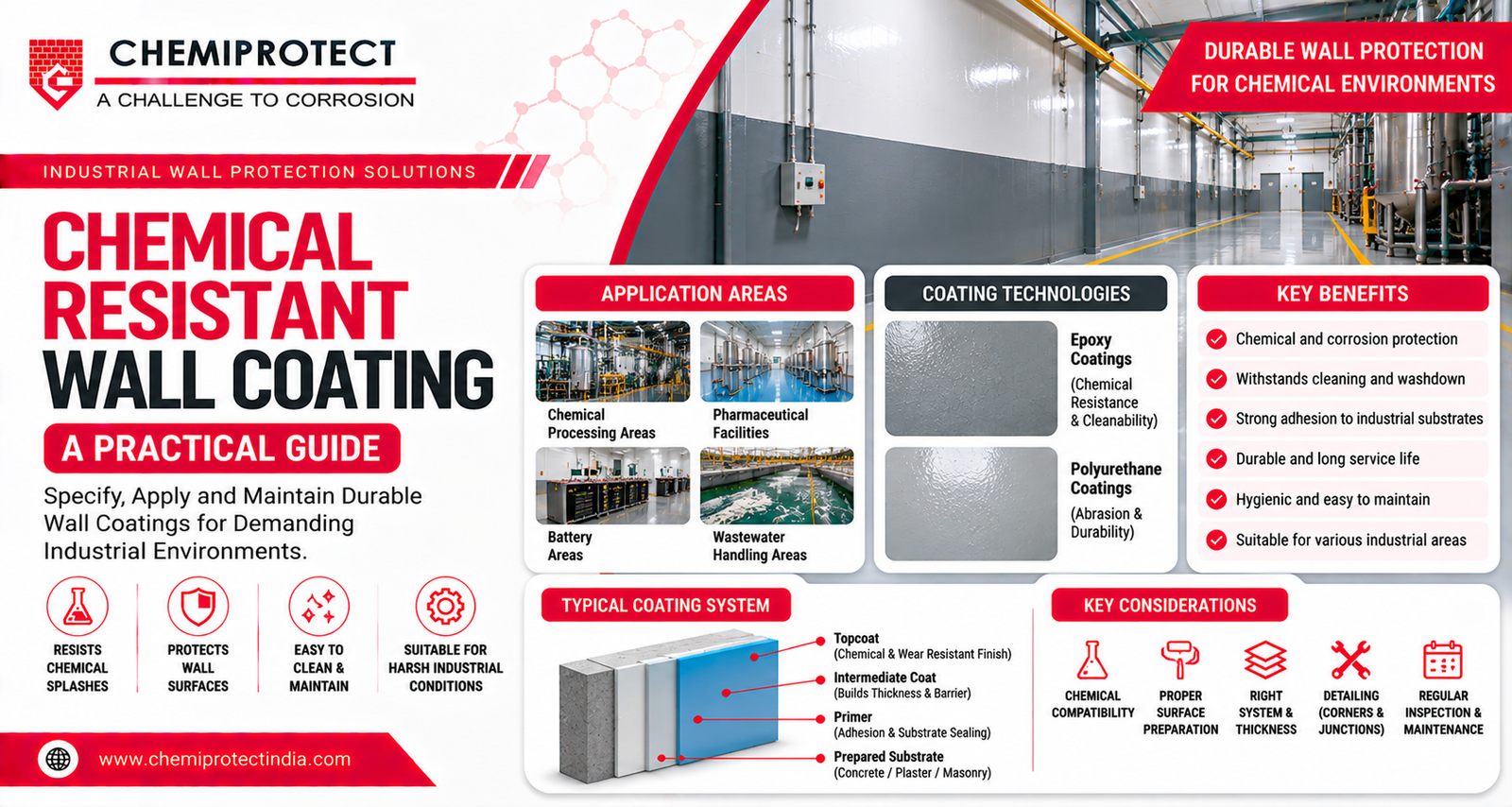
Learn to specify chemical resistant wall
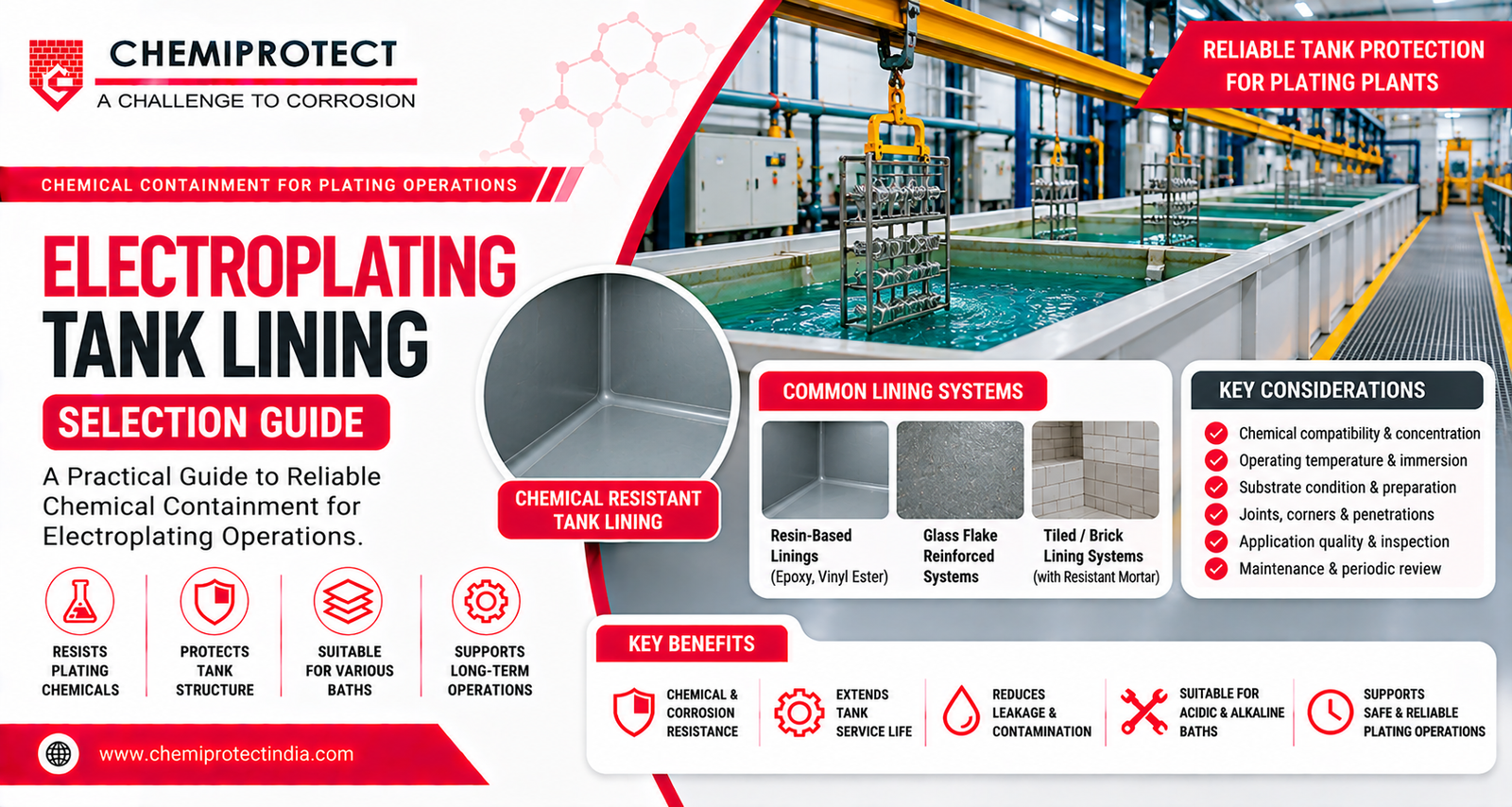
Understand electroplating tank lining, chemical compatibility,
Connect Now