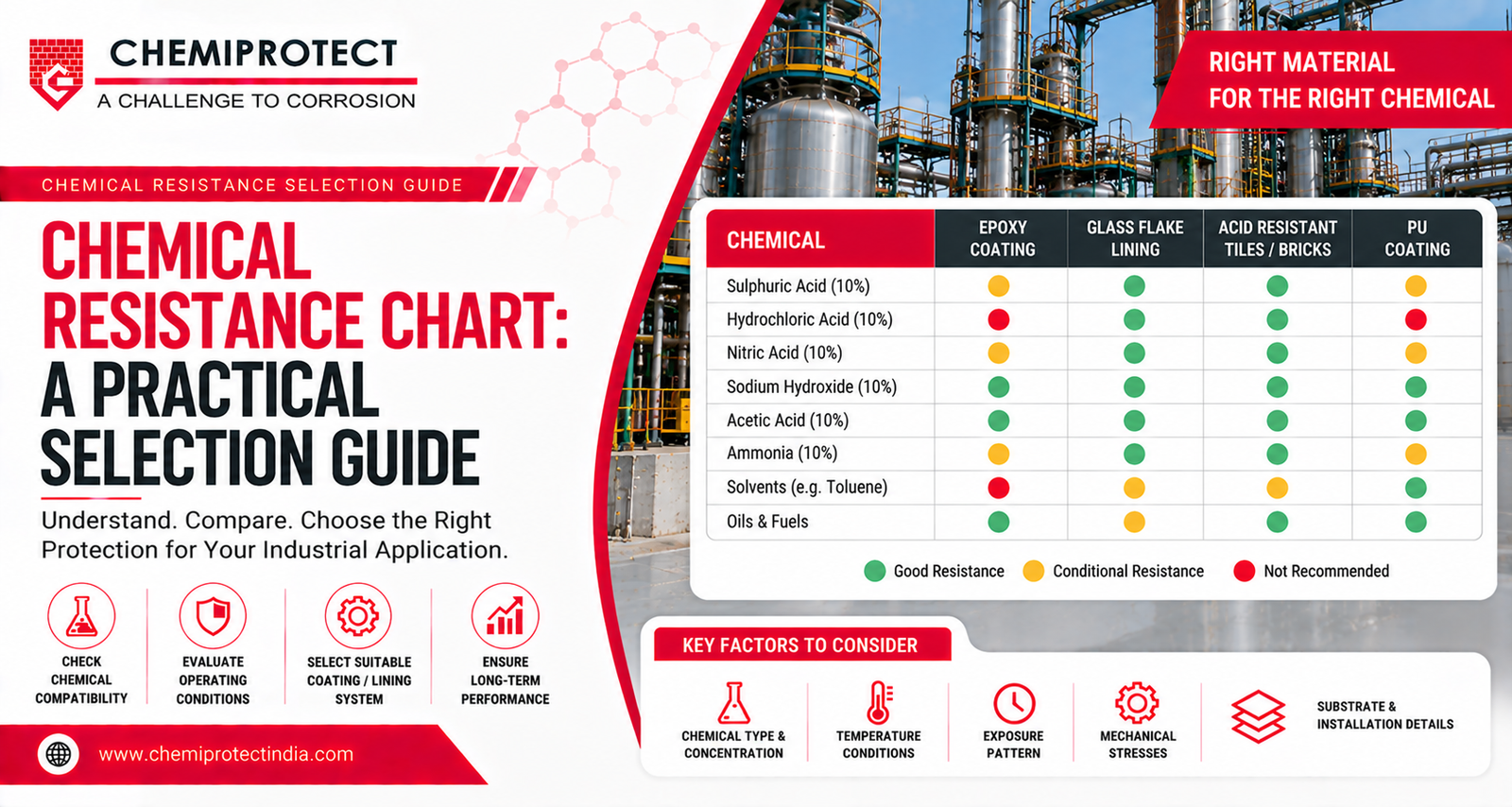
How to Read a Chemical Resistance Chart for Industrial Applications
Learn how to read a chemical
Effluent treatment plants handle wastewater that can contain acids, alkalis, dissolved salts, process chemicals, suspended solids, cleaning agents, and aggressive substances. Depending on the industry and treatment process, tanks, pits, channels, floors, sumps, and containment areas may remain exposed to corrosive liquids and wet conditions for extended periods.
Concrete and other construction substrates can deteriorate when aggressive liquids penetrate their surfaces. An appropriate acid resistant lining creates a protective barrier between the treated surface and the underlying substrate, helping reduce chemical penetration and supporting longer service life. Industrial projects can use acid resistant lining solutions where the exposure conditions require a dedicated chemical protection system.
ETP protection should not be specified as one generic system for the entire plant. Different zones can experience different chemical concentrations, temperatures, immersion conditions, abrasion, and cleaning requirements. The lining should therefore be selected according to the actual service conditions of each area.
Acid resistant lining is a protective system applied over a suitable substrate to reduce damage caused by acids, alkalis, corrosive wastewater, and other aggressive liquids. In an effluent treatment plant, the lining may be used on tanks, pits, channels, drains, floors, walls, bunds, and other surfaces that require chemical protection.
Depending on the application, a lining system can combine substrate preparation, primer, membrane or interliner, chemical-resistant bedding and jointing mortar, and acid-resistant tiles or bricks. Resin-based coatings and glass-flake reinforced systems can also be considered where a seamless protective barrier is more suitable.
Chemical compatibility, adhesion, joint integrity, thickness, substrate condition, detailing, and installation quality all influence performance. The selection of chemical resistant lining systems should follow the chemical and physical conditions of the service area.
Equalization tanks and collection zones can receive wastewater with variable chemical characteristics. Surfaces may experience prolonged contact with contaminated liquids, making chemical compatibility and moisture resistance important considerations.
Neutralization processes can involve acidic and alkaline streams. Tanks, pits, channels, and surrounding floors should be assessed for the chemicals, concentrations, temperatures, and exposure cycles expected during operation.
Chemical dosing areas may experience splashes, spills, and localized exposure from treatment chemicals. Floors, bunds, equipment bases, and containment surfaces can require localized chemical-resistant protection.
Sludge handling areas may combine moisture, chemicals, solids, abrasion, and cleaning activity. The selected protection should account for both chemical exposure and mechanical wear.
Drains, channels, and sumps can remain wet and may receive concentrated liquids. Their joints, corners, transitions, and interfaces with drainage components require careful detailing.
The lining should be compatible with the actual wastewater and chemicals present in the service area. Chemical type, concentration, temperature, contact time, frequency, and immersion conditions should be considered.
Many ETP surfaces remain wet or submerged for significant periods. The system must suit the expected moisture and immersion conditions.
Solids, maintenance activity, equipment movement, and cleaning can cause physical wear. Areas with higher mechanical exposure may require a more robust lining build-up.
The lining must bond effectively to the prepared substrate. Concrete condition, surface profile, moisture, cracks, previous coatings, and repairs should be assessed before application.
Joints, drains, corners, pipe penetrations, floor-wall junctions, and equipment bases can become vulnerable points. These details should be incorporated into the overall protection design.
Selection should begin with an exposure assessment for each plant zone. Identify the wastewater characteristics, treatment chemicals, expected concentration ranges, operating temperature, immersion or splash exposure, cleaning procedures, and duration of chemical contact.
Concrete may contain laitance, dust, oil, cracks, voids, damaged sections, moisture, or previous coatings. These conditions influence surface preparation and system selection.
Traffic, abrasion, impact, thermal cycling, vibration, and maintenance operations may affect the required system. A lining that performs well chemically may still be unsuitable if the physical conditions are not considered.
Where tiled or brick-lined systems are specified, the bedding and jointing mortar must be compatible with the facing material and chemical environment. For seamless applications, resin type, reinforcement, thickness, and curing requirements should be evaluated according to the service conditions. The choice of chemical resistant construction materials should also account for the complete lining build-up and substrate requirements.
Reliable lining performance requires a suitable substrate. Concrete should be inspected for laitance, dust, oil, loose material, cracks, voids, damaged areas, moisture, and previous coatings. Unsound or contaminated material should be removed and repaired with compatible materials.
Mechanical surface preparation may be required to establish a clean and suitably profiled surface. Moisture conditions should be assessed against the requirements of the selected system, particularly in tanks, pits, sumps, and floors exposed to continuous process liquids.
Proper preparation supports adhesion and reduces the risk of premature failure. It should therefore be treated as a critical part of the ETP lining specification rather than as a separate preliminary activity.
Depending on the selected system, installation may include substrate preparation, primer, repair layer, membrane or interliner, resin layers, protective topcoat, chemical-resistant mortar, or acid-resistant brick and tile facing. Product instructions and the specified application procedure should govern mixing, thickness, curing, and recoat requirements.
Quality checks should cover substrate condition, surface cleanliness, moisture where relevant, layer thickness, continuity, joint treatment, corners, penetrations, and curing. Inspection between stages can identify pinholes, missed areas, poor transitions, or other defects before the ETP returns to service.
Drains, channels, movement joints, pipe penetrations, and equipment bases deserve particular attention because they can experience concentrated exposure. Correct detailing helps maintain continuity of the protective barrier.
Routine inspection should look for cracking, blistering, abrasion, impact damage, delamination, exposed substrate, and deterioration around joints, drains, penetrations, and equipment bases. Early identification of localized damage can help prevent more extensive deterioration.
Changes in wastewater composition, chemical concentration, operating temperature, treatment chemicals, or cleaning procedures should prompt a review of the existing lining system.
Service planning should also consider shutdown windows, access, curing requirements, and safe return to operation. Timely maintenance can help preserve the protective barrier and support dependable ETP operation.
Acid resistant lining is an important consideration for effluent treatment plants where concrete and other substrates may be exposed to corrosive wastewater, treatment chemicals, moisture, immersion, abrasion, and repeated cleaning. The right system can help limit chemical penetration and protect critical plant surfaces.
The appropriate lining should be selected according to the actual exposure profile of each ETP zone. Chemical compatibility, concentration, temperature, immersion, mechanical conditions, substrate quality, drainage, joint detailing, installation, and maintenance requirements should all be evaluated before specification.
A complete protection approach may combine substrate preparation, primer, interliner, chemical-resistant mortar, acid-resistant bricks or tiles, resin-based lining, or glass-flake reinforcement depending on the application. Chemiprotect Engineers provides acid-resistant lining, epoxy, glass-flake, PU, and related industrial protection solutions for demanding environments. Explore the company’s industrial protection solutions to evaluate suitable protection approaches for your project.
When used with chemical resistant masonry units and the proper membrane MIPRO-VE will protect concrete and steel sub base from chemical attacks and physical abuse. MIPRO-VE is silica filled vinyl ester mortar supplied in two parts .
Learn how to read a chemical
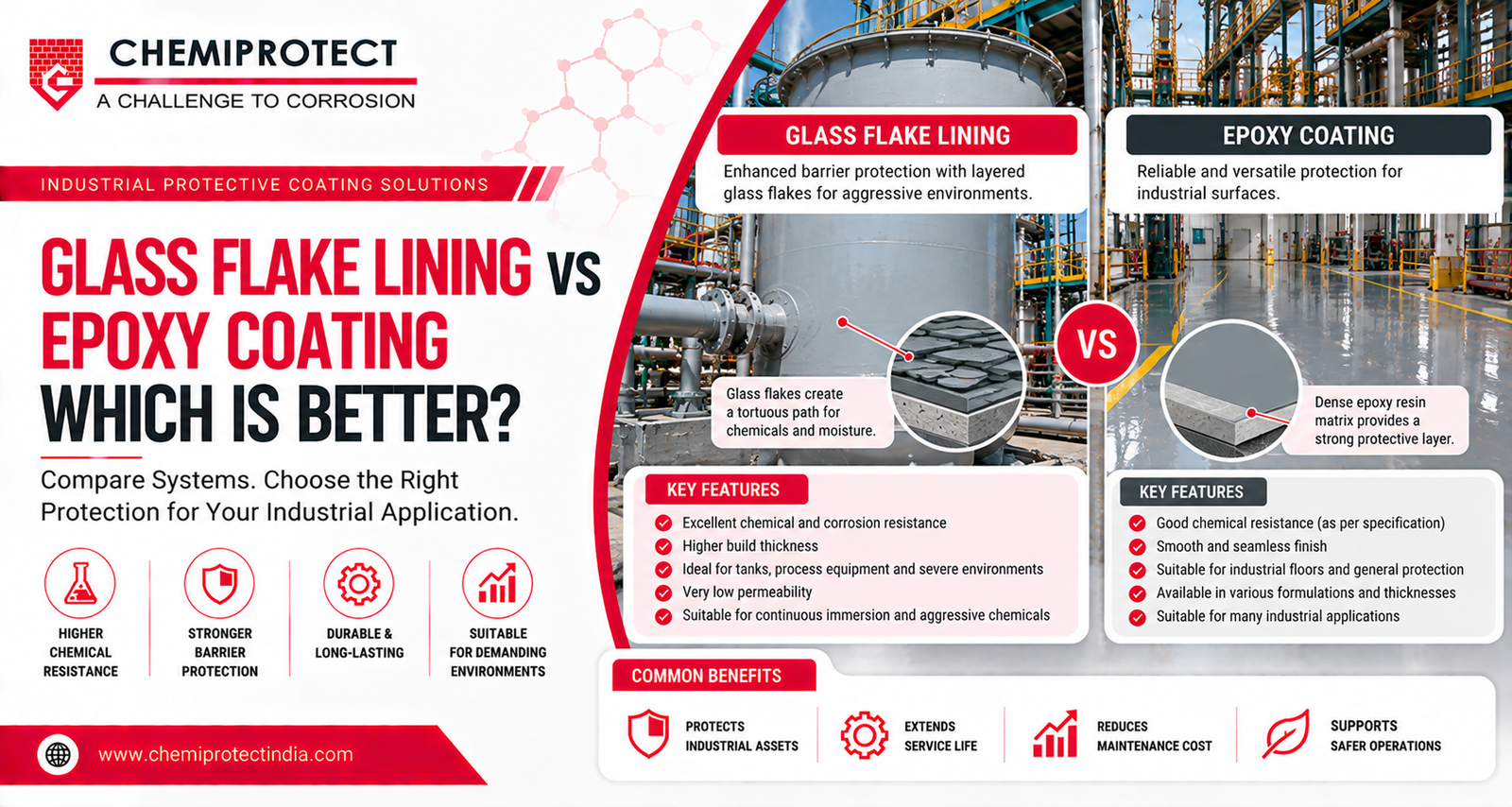
Understanding Glass Flake Lining and Epoxy
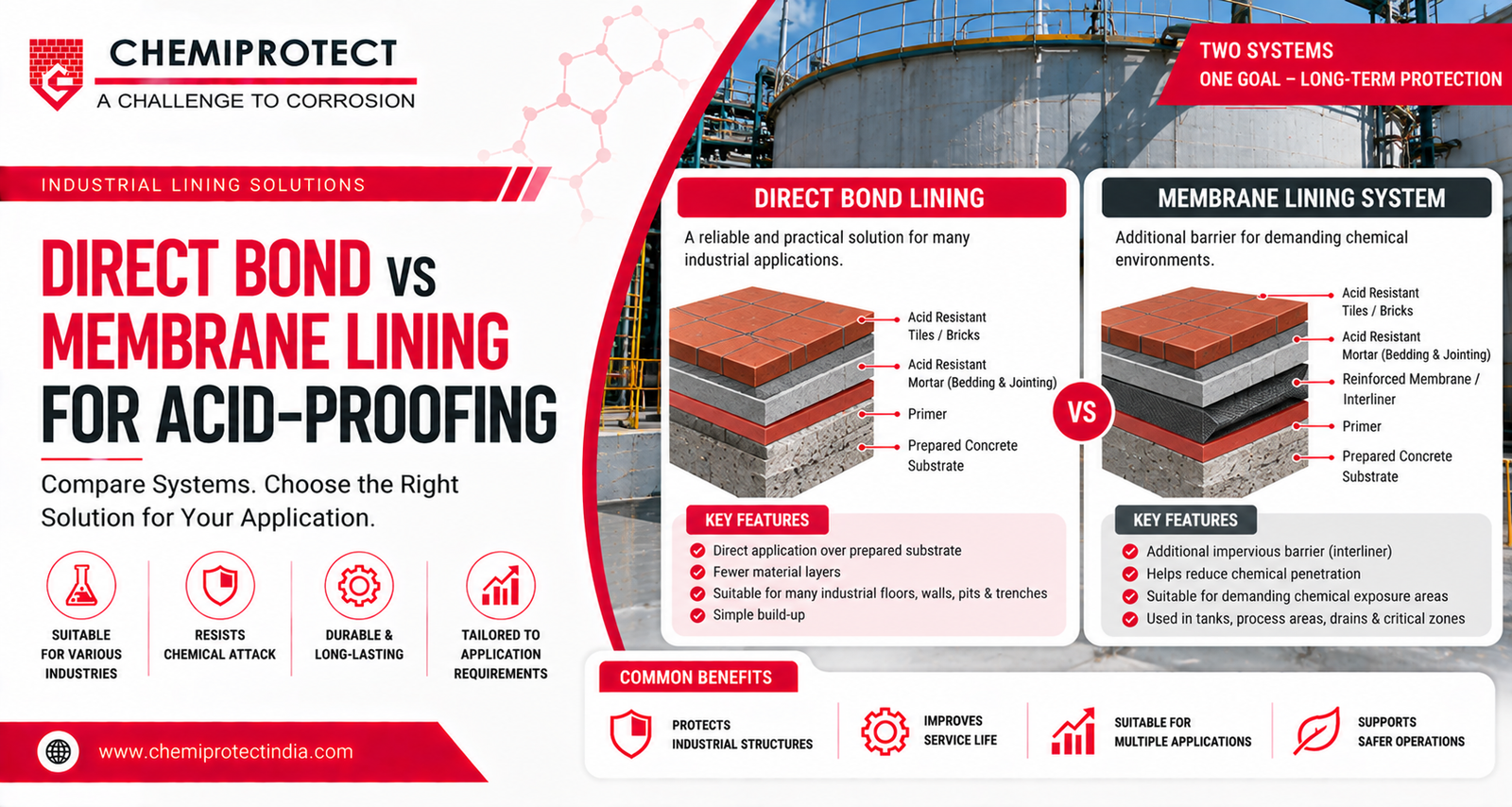
Understanding the Difference Between Direct Bond
Connect Now